About Plicaturopsis crispa (Pers.) D.A.Reid
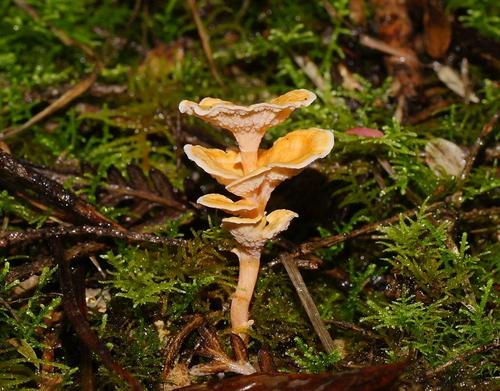
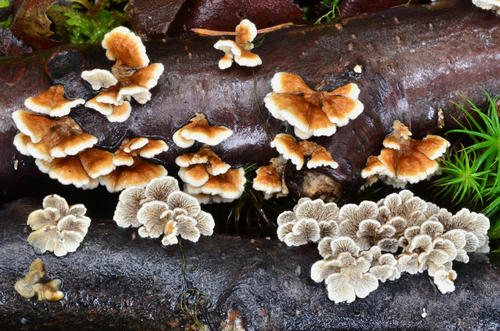
Plicaturopsis crispa (Pers.) D.A.Reid typically grows in clusters on decomposing branches of deciduous trees. Its fruiting bodies are bracket-like, semi-circular and shell-shaped, usually 1 to 3 cm long. The upper surface is marked with concentric zones that become paler toward the edge. The underside is covered in pale, forked folds that create a gill-like appearance. It produces small, narrow allantoid white spores that are weakly amyloid, measuring only 3–4.5 x 1–1.2 μm. Ecologically, Plicaturopsis crispa acts as an effective decayer in the initial phase of wood decomposition. It predominantly colonizes dead branches of deciduous trees, specifically Fagus and Betula, and causes white rot. A few years into the wood decomposition succession, stronger competing fungi such as Trametes versicolor and the split-gill fungus Schizophyllum commune often displace P. crispa.