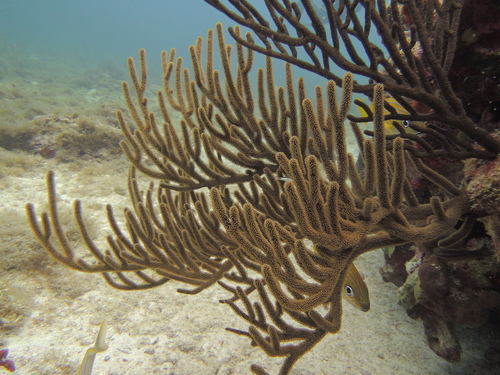
About Plexaura homomalla (Esper, 1794)
Plexaura homomalla forms bushy or candelabra-like colonies made of upright branches. It tends to branch in a single plane, with a small number of dichotomous forks, and produces mostly lateral branches. This coral grows to a height of approximately 35 cm (14 in) and has two recognized forms: P. h. forma kuekenthali is taller and slimmer, with narrow terminal branches, while P. h. forma homomalla is shorter with more robust terminal branches. The coral's central stalk and branches are black or dark brown, and its polyps are cream-coloured, yellow, or pale brown. The calyces, out of which polyps protrude, typically do not project, though they may be slightly raised above the coral's surface. Plexaura homomalla grows on reefs in the Caribbean Sea, the Gulf of Mexico, the Bahamas, and Florida. It occurs at depths down to about 55 m (180 ft), with P. h. forma homomalla being more abundant in shallow waters, and P. h. forma kuekenthali occurring mostly at greater depths. Plexaura homomalla tissues contain a high concentration of the lipid prostaglandin A. This physiologically active substance is a million times more abundant in this coral's tissues than in the tissues of most other animals. The function of this large amount of prostaglandin in the coral itself is unknown. In mammals, prostaglandin acts as a muscle relaxant, and it is used to induce labour, where it causes nausea and vomiting. Plexaura homomalla is 2 to 3% prostaglandin by weight, and it was used as a source of this drug until synthetic production methods became available in the 1970s. In experiments, killifish of the family Cyprinodontidae and yellowhead wrasse (Halichoeres garnoti) vomited after being fed gelatine pellets that contained prostaglandin. During feeding trials, the fish quickly learned to avoid these prostaglandin-containing pellets, while continuing to accept control pellets that did not contain the substance. This indicates that the prostaglandin produced by the coral likely acts as a chemical defence, deterring predatory fishes from feeding on it.

