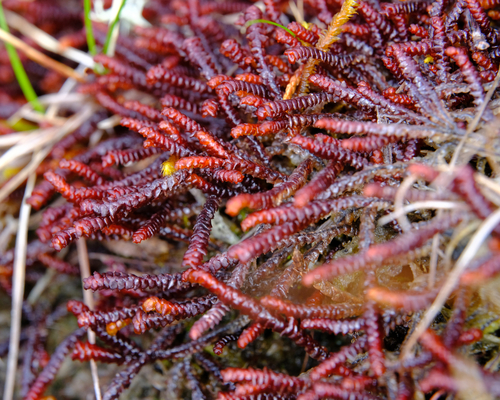
About Pleurozia purpurea Lindb.
Pleurozia purpurea Lindb. is a thalloid liverwort. It is made up of worm-like thalli that frequently form creeping mats, which may be either branched or unbranched. As suggested by its scientific name, P. purpurea is most often red, dark red-green, or purple in color. Even though it is a thalloid liverwort, this species produces large, egg-shaped, concave leaves. The sac-like shape of its upper leaves enables the plant to collect water, a trait that is unique to liverworts of the genus Pleurozia. Its leaves are arranged in four rows: two rows of large leaves on the upper side of the plant, and two rows of smaller leaves on the lower side. Like in other liverworts, oil bodies and trigones are visible in the leaves of this species. Pleurozia purpurea grows in bog environments across the world. Confirmed locations where this species has been found include western Scotland, western Ireland, Norway, the Faroe Islands, Jan Meyen Island, the Himalayas, Alaska, Guadeloupe, and Hawaii. This plant most commonly grows along the edges of bogs, fens, and pools. It can also be found growing on lawns and other water-saturated areas at high elevations, including blanket bogs, wet heath, montane turf, scree, and peat-covered rock ledges. It grows in a matted form across these wet surfaces. Recent research has found that Pleurozia purpurea practices zoophagy. Its sac-shaped leaves easily collect and store water, and the plant has been observed trapping the protozoan species Blepharisma americana. Studies have also found that this protozoan is attracted to the plant, which regularly and purposefully traps small animals.

