About Pleurotus ostreatus (Jacq.) P.Kumm.
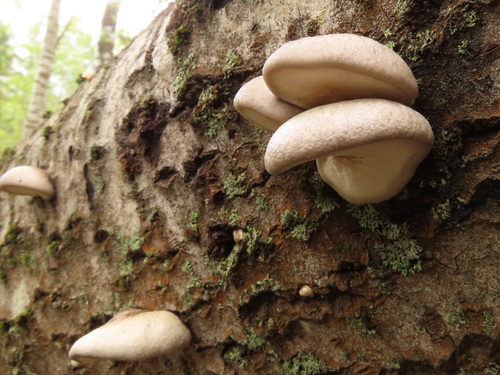
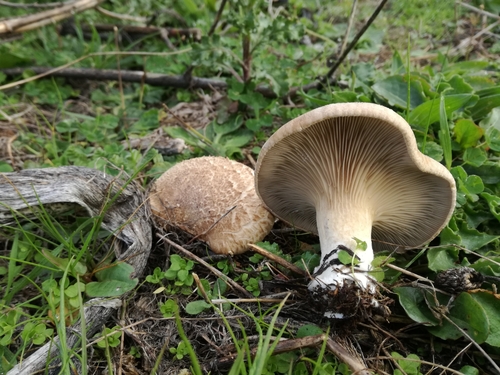
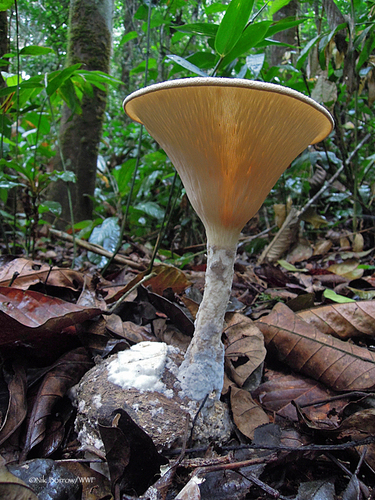
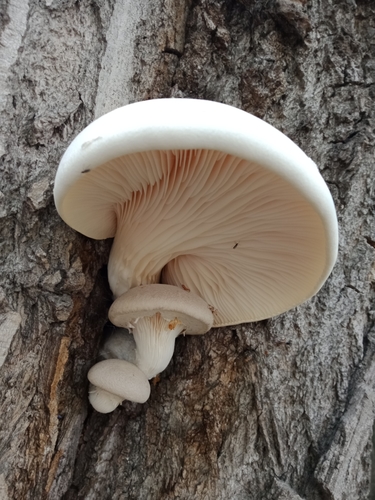
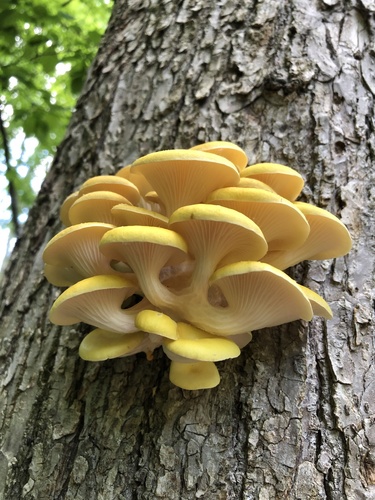
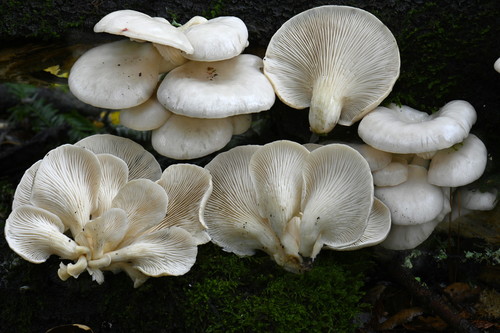
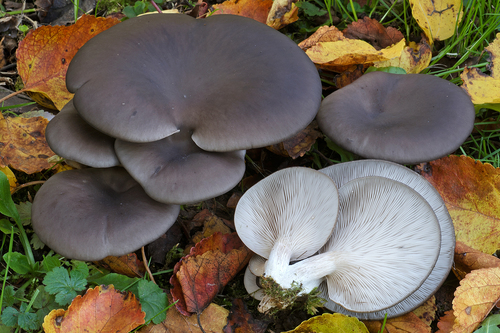
Pleurotus ostreatus (Jacq.) P.Kumm., commonly known as the oyster mushroom, has a broad cap that is fan- or oyster-shaped, measuring 2–30 centimetres (1–12 inches) wide. Wild specimens have caps ranging in color from white to gray or brown; when young, the cap margin is inrolled, and the cap surface is smooth and often somewhat lobed or wavy. Its flesh is white, firm, and varies in thickness based on stipe arrangement. If a stipe is present, it grows up to 4 cm (1+1⁄2 in) long, is thick, off-center, and attaches laterally to wood. The gills are whitish, sometimes becoming yellowish with age, and are decurrent when a stipe is present. The spore print is white to lilac-gray, and is easiest to see against a dark background. This mushroom has the bittersweet aroma of benzaldehyde, or bitter almonds. This species is widespread across many temperate and subtropical forests throughout the world, though it is not found in the Pacific Northwest of North America, where it is replaced by P. pulmonarius and P. populinus. It is a white-rot wood-decay fungus and a saprotroph that acts as a primary decomposer of wood, especially deciduous trees, and beech trees in particular. It can be found in a wide range of habitats, and grows year-round in the United Kingdom, while some related species such as the branched oyster mushroom only grow on trees. While this mushroom is often seen growing on dying hardwood trees, it only acts saprophytically rather than parasitically. It colonizes dead and dying wood as the tree dies from other causes, and benefits forest ecosystems by decomposing dead wood to return vital elements and minerals into a form usable by other plants and organisms. Oyster mushrooms of this species bioaccumulate lithium. Predatory behavior on nematodes has evolved independently in all major fungal lineages, and P. ostreatus is one of at least 700 known nematophagous mushrooms. Its mycelia can kill and digest nematodes, which is thought to be a strategy for the mushroom to obtain nitrogen. Commercial cultivation of this mushroom first started in Germany as a subsistence measure during World War I, and it is now grown commercially around the world for food. It is also called the pearl oyster mushroom, and is used to make mycelium bricks, mycelium furniture, and leather-like products. Oyster mushrooms are also used industrially for mycoremediation. They have been used to treat diesel oil-polluted soil, and can convert 95% of the oil into non-toxic compounds. P. ostreatus can also grow on and degrade oxo-biodegradable plastic bags, and can contribute to the degradation of renewable polyethylene. This species has been found to contain lovastatin, a cholesterol-lowering compound.