About Pleurotus dryinus (Pers.) P.Kumm.
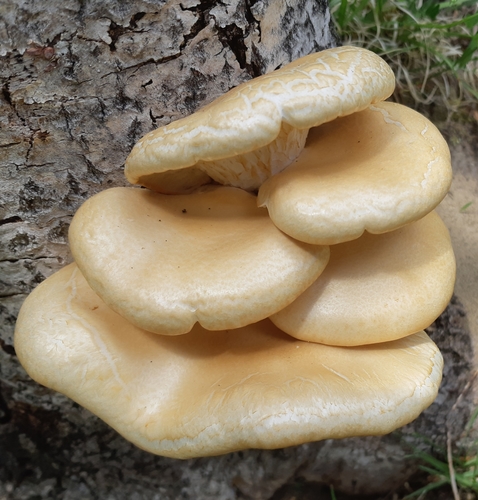
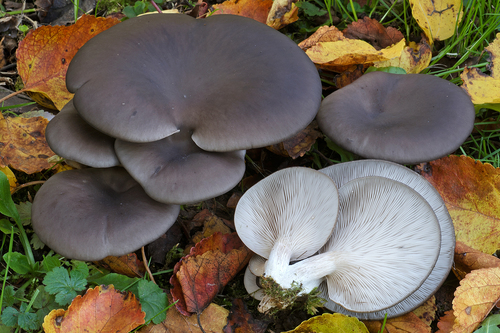
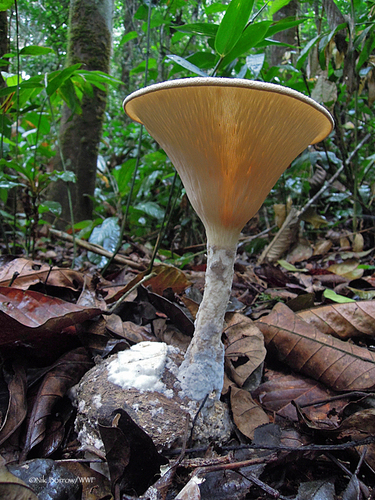
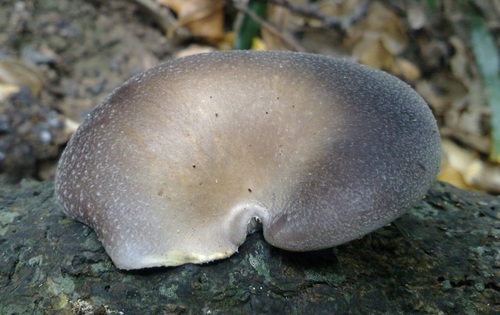
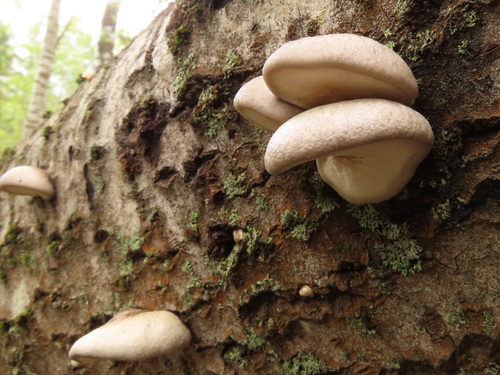
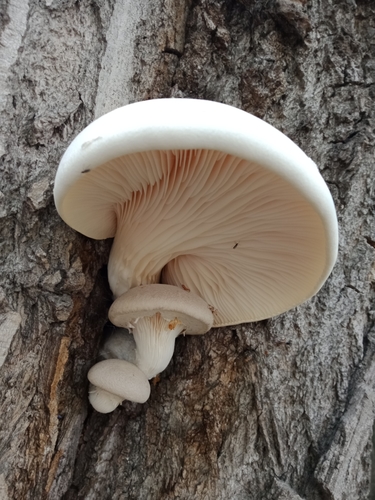
Pleurotus dryinus has a cap that reaches up to 20 centimetres (8 inches) across. The cap color ranges from pale to beige, and may become yellowish with age. Veil remnants often stick to the cap edge. Young caps have a velvety, tomentose texture; this tomentum can develop into grey-brown scales. Mature, old specimens have a bare surface that may crack. The whitish to pale brownish lateral stem is usually between very short and 10 cm long, and it typically bears a membranous ring. Its gills run decurrently far down the stem, and may criss-cross (anastomose) at the bottom of the stem. The gills are white, and sometimes turn yellowish. The scent of this species is variously described as pleasant, slightly polypore-like, or complex with faint fruity or sour notes. Its taste is mild. Microscopically, the flesh can be either monomitic or dimitic. When dimitic, extra thick-walled hyphae are present, which give the flesh a tough consistency, similar to the texture of ordinary fragile mushrooms. This species does not have cystidia. Its spores are elongated, shaped like a rounded cylinder, and measure approximately 9–15 μm by 3–5 μm. Fruiting occurs from summer through autumn. It is distributed across Europe, where it ranges locally from common to rare, and also occurs in North America. This fungus is saprobic on dead wood, and can also act as a weak parasite that causes white rot in living trees. It grows most often on oak, a fact reflected in its species name, but can also grow on beech and other broad-leaved trees, and only occasionally appears on conifers. It is typically found either solitary or in small groups. Pleurotus dryinus is edible, though older specimens are tough, and is considered less desirable than other more well-known species in the genus Pleurotus. Like some other Pleurotus species, P. dryinus attacks nematodes, and may be used as a method to control these parasites when they infect cats and dogs.