About Pleurotus djamor (Rumph. ex Fr.) Boedijn
Scientific name: Pleurotus djamor (Rumph. ex Fr.) Boedijn
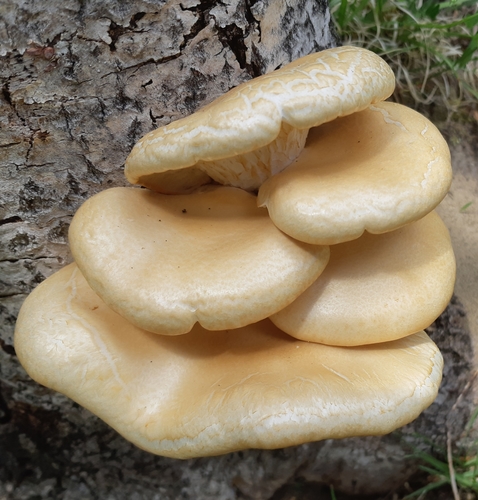
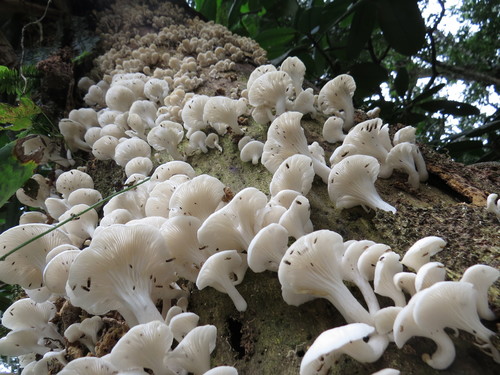
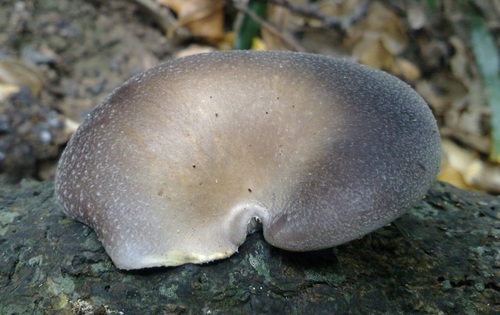
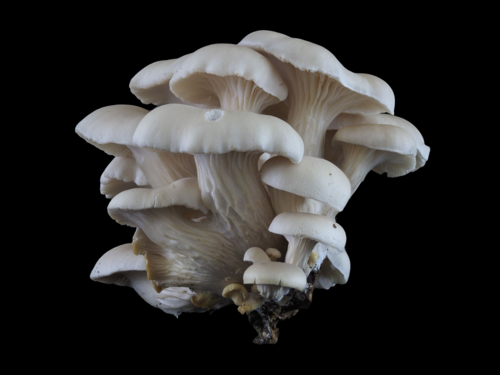
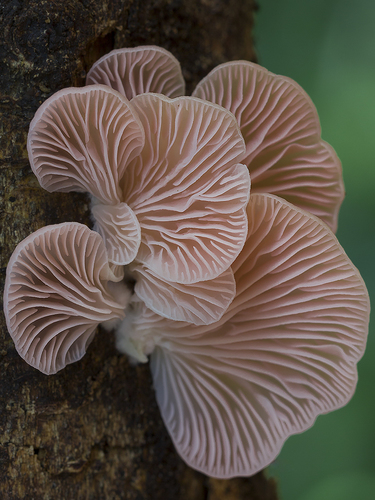
Macroscopic characteristics: Commonly called the pink oyster mushroom, this species typically has a pink color, though a white form also exists. Its cap is fan-shaped, ranging from broadly convex to plane, measuring 2–5 cm broad and 3–7 cm long, with an inrolled margin. The gills range in color from light pink to cream, and are 0.5–0.7 μm in width. The stem is white with matted hairs, and is either very short or entirely absent. The flavor of pink oyster mushroom is described as meaty and fishy, and it is quite umami like most mushrooms. Its texture is both meaty and chewy. When fried until crispy, it resembles bacon or ham. When raw, however, it has a sour taste. It is very rarely found in supermarkets because it only has a shelf life of about one day, and quickly develops an unpleasant amine or urine-like odor after this period. It is only harvested from spring to fall, so it is only available during these seasons.
Microscopic characteristics: The spore print is pink, and the spores are inamyloid and ellipsoid. The spores measure 7–8 × 3–4.5 μm. Basidia measure 24.93–25.26 × 6.7–7.4 μm, and each bears 4 spores. Sterigmata are 1.5–1.75 μm in size. Clamp connections are present.
Ecology and distribution: Pink oyster mushroom grows in tropical and subtropical regions, ranging as far north as Japan and as far south as New Zealand. In Hawai'i, it often grows on fallen coconuts and palm frond stalks; it can also be found growing on fallen ōhiʻa branches in forests on the Hawaiian island of Kaua'i.
Uses and benefits: Pink oyster mushrooms are best suited for cooked preparations including sautéing, boiling, roasting, and frying. They can be sautéed or stir-fried with other vegetables, added to pasta dishes, sprinkled on top of pizza, added to grain bowls, sautéed with eggs, boiled in soups, chowders, or stews, or cooked into risotto. They can also be sautéed and mixed into cream-based white sauces to add extra flavor. Due to their meaty texture, these mushrooms require thorough cooking to develop their full flavor and an edible consistency. Pink oyster mushrooms are widely cultivated. They require less water spraying during fruiting than the Italian oyster mushroom. They can be grown at relatively warm temperatures between 25 and 30°C, and can be cultivated on barley straw, sawdust, tea leaves, and wheat straw. Compared to other mushrooms, pink oyster mushrooms contain higher levels of vitamin C and potassium.