About Pleurotus cornucopiae (Paulet) Quél.
Scientific name: Pleurotus cornucopiae (Paulet) Quél.
Description All information in this description draws on the provided cited references.
Microscopic characteristics The flesh of this species may be monomitic, like most ordinary fragile mushrooms, or dimitic. DIMITIC flesh contains additional thick-walled hyphae that give the flesh a tougher consistency, particularly in older specimens. Spores are somewhat elongated ellipsoids, measuring around 8-12 μm by 3.5-5.5 μm. No cystidia are present.
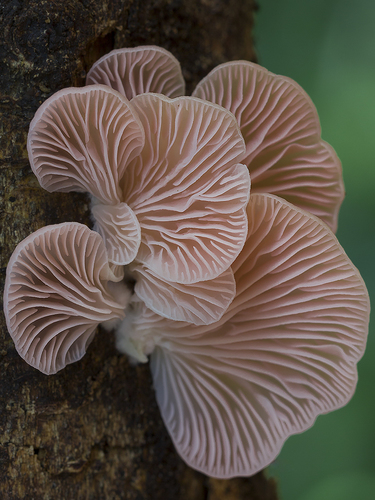
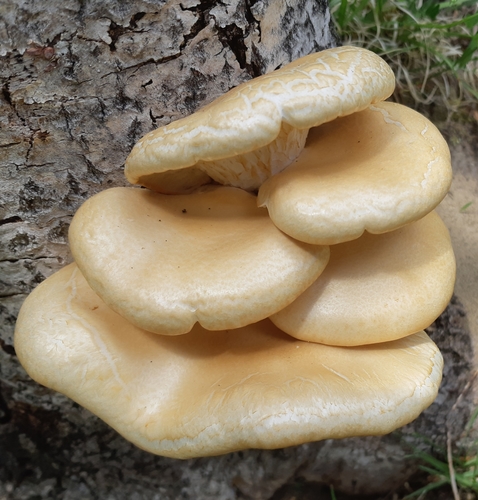
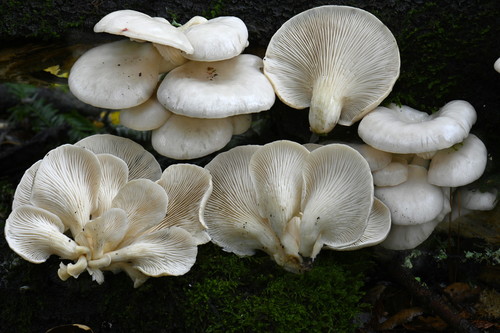
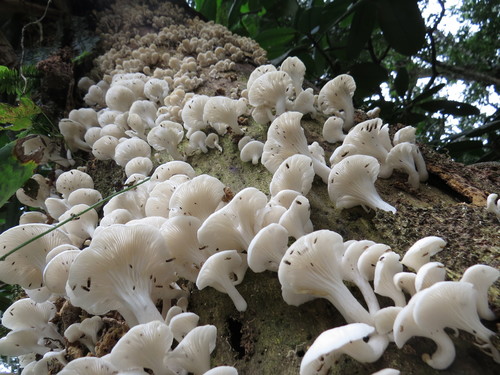
Distribution and habitat This mushroom grows as a saprobe on dead wood, and can also act as a weak parasite. It grows on stumps and fallen trunks of oak, beech, elm, and other broad-leaved trees. Fruiting bodies appear from spring to late summer. In the wild, it is distributed across Europe (where it fruits from August to November), and its local abundance ranges from common to fairly rare. It has also been reported growing wild in the U.S. and Mexico.
Ecology It acts as a mild parasite of broad-leaved trees.
Uses This mushroom is edible, and is cultivated in a method similar to the cultivation of Pleurotus ostreatus, though less extensively. For eating, the best specimens are young, and their tough stems should be discarded. A Chinese study evaluated multiple commercially available varieties of P. cornucopiae, and found that an appropriate growth medium for cultivation in the Shanghai area is a mixture of cotton-seed hulls and wood-chips with 65% water content. Another study, which focused on the yellow-topped form of this species, also suggested pasteurized switch grass as a usable cultivation substrate, though the yield from switch grass was lower than the yield from cotton-seed hulls and straw.