About Pleurotus citrinopileatus Singer
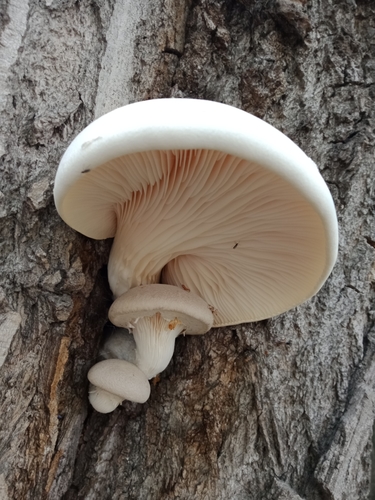
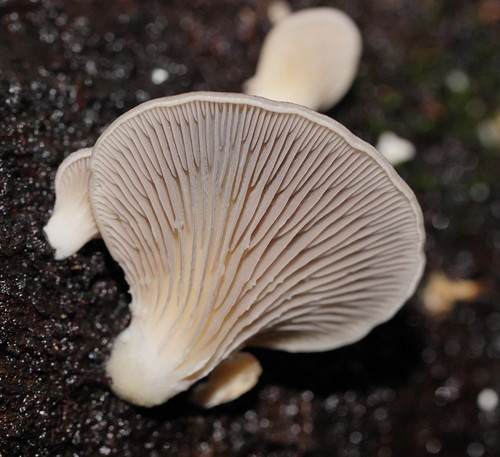
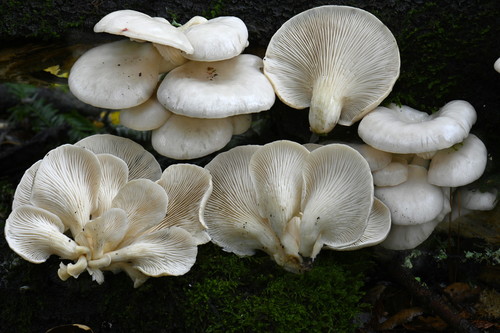
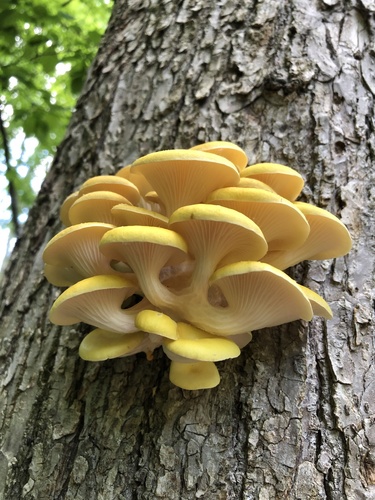
Pleurotus citrinopileatus Singer, commonly known as the golden oyster mushroom, produces fruiting bodies that grow in clusters. Its caps range in color from bright yellow to golden brown, have a velvety, dry surface texture, and measure 2–10 centimetres (3⁄4–4 inches) wide. The flesh of the mushroom is thin and white, with a mild scent and mild flavour. Its stems are cylindrical, white in color, often curved or bent, reaching about 2–5 cm (3⁄4–2 in) long and 2–8 mm (1⁄16–5⁄16 in) in diameter. The gills are white, closely spaced, and run down the stem. The mushroom's spores are cylindrical or elliptical in shape, smooth, hyaline, and amyloid, with dimensions of 6–9 by 2–3.5 micrometres, and it produces a light pink spore print. Like other oyster mushrooms, this species is a wood-decay fungus. In the wild, it most commonly decays hardwood trees such as elm. The first recorded observation of naturalized golden oyster mushrooms in the United States was documented in 2012 on Mushroom Observer, an occurrence that came roughly a decade after commercial cultivation of the species began in North America. Naturalized populations have since been found growing on oak, elm, beech, and other hardwoods across many U.S. states, including Delaware, Illinois, Iowa, Maryland, Massachusetts, Michigan, Minnesota, New York, Ohio, Pennsylvania, and Wisconsin. The species undergoes vigorous range expansion that is comparable to invasive species. A 2018 population genomics study compared naturalized wild isolates of the mushroom with commercial strains, and found that two of the tested commercial isolates showed high genetic similarity to all tested wild isolates, suggesting these may be the source strains for the current wild populations. The study also found highly genetically similar wild isolates collected from geographically distant locations, in some cases over 1,300 kilometres (800 mi) apart. This provides strong evidence that the same cultivated strain has been reintroduced many times across different parts of the U.S., rather than the species spreading from a single initial introduction event. This mushroom is also naturalized in several African countries: Cameroon, Tanzania, Kenya, Burundi, and Nigeria. It also occurs in the wild in some Asian countries outside of its native territory: Yemen, Korea, and India. Golden oyster mushrooms are cultivated commercially, most commonly grown on a growing medium of grain, straw, or sawdust. Alternative growing substrates that can be used include grape and olive pomace. Pleurotus species are some of the most commonly cultivated mushrooms globally, particularly in China, because they are easy to cultivate and can convert 100 grams of organic refuse into 50–70 grams of fresh mushrooms. In the Russian Far East, the species is called iI'mak, and it is one of the most popular wild edible mushrooms.