About Pleuroploca trapezium (Linnaeus, 1758)
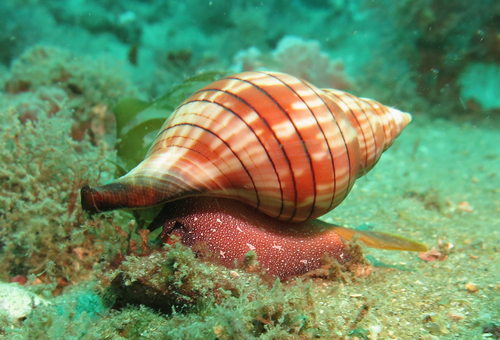
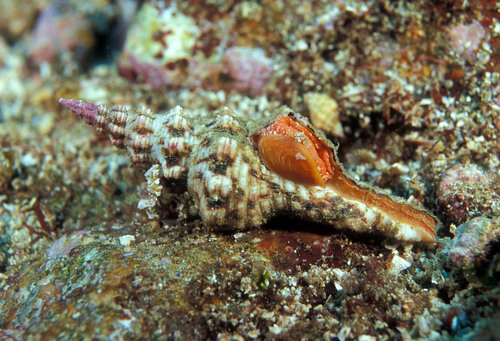
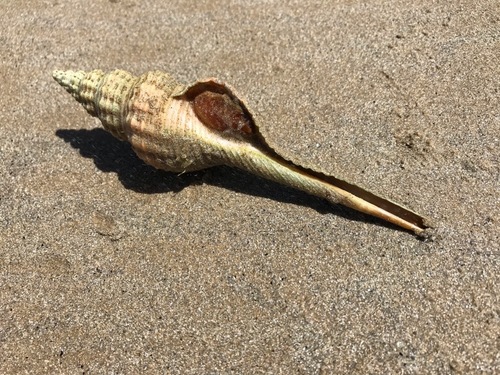
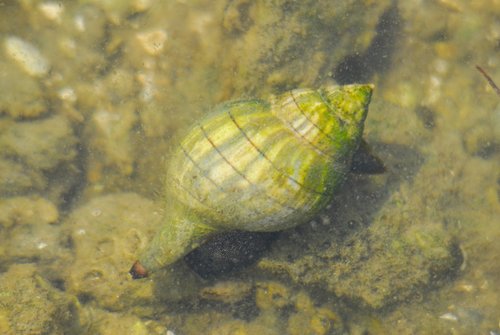
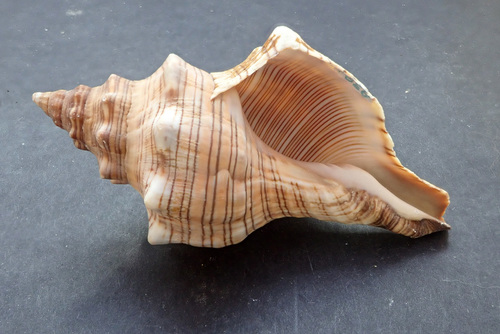
The shell of Pleuroploca trapezium is solid, heavy, and golden brown in color. Adult shells range in length from 85 mm to 250 mm, with a typical maximum length of 200 mm. Its spire is moderately long, and the apex is usually eroded. The shell's sutures are constricted. The shoulders of its whorls are covered in spiral rows of strong, slightly pointed nodules. The entire shell surface is covered with fine, brown, incised spiral lines that mostly occur in pairs. Where these paired lines reach the edge of the outer lip, the lip becomes dentate, with seven pairs of teeth. The oval aperture is pale in color and has strong internal ridges. The columella is smooth along its posterior section. The siphonal canal is extended but short, and the fasciole is weak. In the Seychelles, Pleuroploca trapezium has been observed preying on the spiny cerith, Cerithium echinatum. This species occurs in the Red Sea and the Indian Ocean, along the coasts of Aldabra Atolls (Seychelles), Madagascar, Mauritius, Mozambique, Réunion (France), South Africa, and Tanzania. In the Pacific Ocean, it ranges from Japan south to Melanesia, New Caledonia (France), and North Queensland, and is only rarely found along other Australian coasts. It inhabits the benthic zone on seagrass beds, at depths from 0 to 40 meters.