About Pleuronectes platessa Linnaeus, 1758
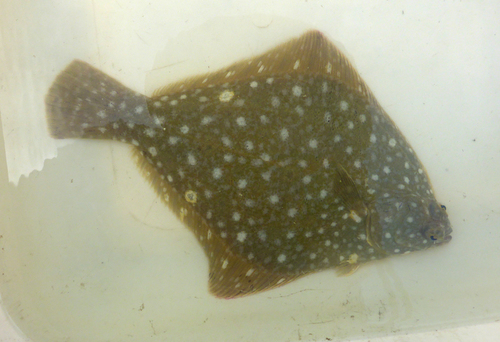
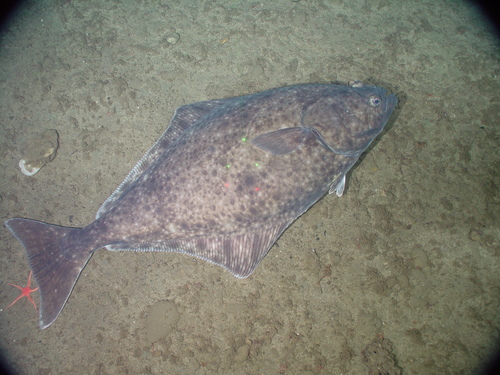
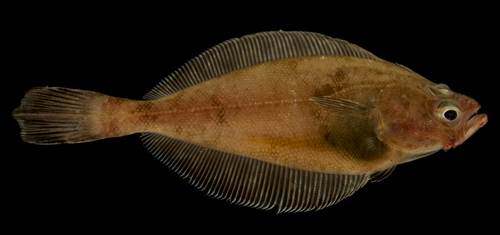
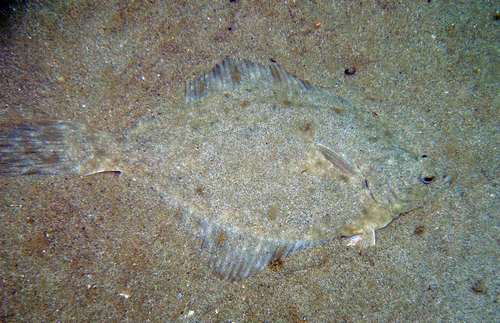
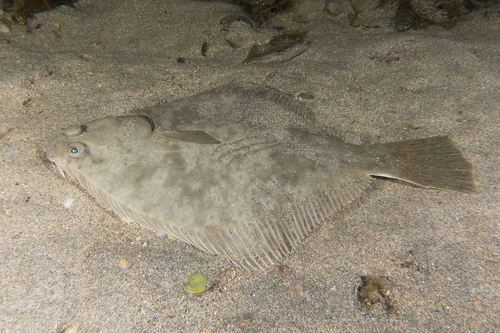
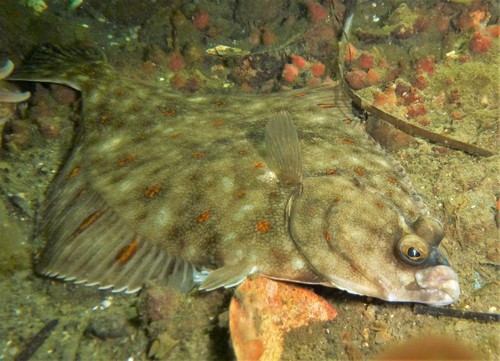
The European plaice, scientifically named Pleuronectes platessa Linnaeus, 1758, has distinct physical characteristics. Its dorsal side has dark green to dark brown skin marked by prominent, irregularly distributed orange spots, while its ventral side is pearly white. The skin is smooth, covered in small scales, and lacks prickles. European plaice can slightly adjust their body color to match their surroundings, but their orange spots always stay visible. Adult European plaice have an oval overall body outline. Their head is fairly small, making up less than 25% of the fish's total length. They have a small pointed terminal mouth, where the maxilla extends just below the right eye. Both of the species' eyes are positioned on the right side of the body, and a defining characteristic of the species is a bony ridge located behind the eyes. The lateral line curves slightly above the pectoral fin. The dorsal fin extends to the eye, and both the dorsal and anal fins are set far from the caudal fin. The anal fin has 48 to 59 soft rays, and is preceded by a spine; the dorsal fin has 65 to 79 soft rays, the pectoral fin has 10 to 11 soft rays, and the ventral fin has six soft rays. European plaice can live up to 20 years, and reach a maximum size of roughly 50 to 70 cm. Individuals as large as 78 cm and weighing up to 5.7 kg have been recorded.
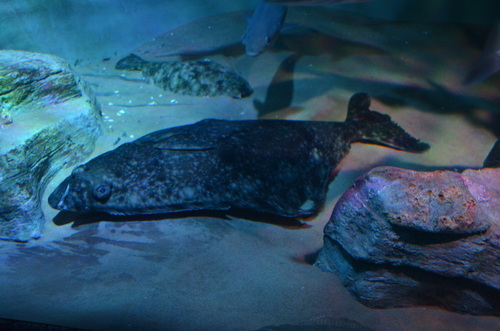
European plaice is a common flatfish that lives on sandy and muddy bottoms of the European continental shelf, most often at depths between 10 and 200 m. Its range extends from the Barents Sea south to the Iberian Peninsula, and it is also found around Iceland and the Faroe Islands. While it is often listed in Mediterranean Sea ichthyological checklists, these records are likely misidentified specimens of European flounder. Adult European plaice typically live in deeper water, while young fish live in shallow habitats such as estuaries and sandy coasts. During the day, plaice burrow into sediment and stay still for long periods, to avoid predators and ambush prey.
Plaice is used as food, and is sometimes the fish included in fish and chips in countries where the dish is popular. It is one of the most commonly consumed fish in North German and Danish cuisine. Filleted, battered, pan-fried plaice is popular both hot and cold as a topping for open sandwiches, served with remoulade sauce and lemon slices. Battered plaice can also be served hot with french fries and remoulade sauce as a main dish; this variation of fish and chips is commonly offered as a children's special in Danish restaurants. Breaded frozen plaice, ready to bake or fry at home, is widely sold in supermarkets. Fresh plaice is also often prepared by oven-baking.