About Pleurocybella porrigens (Pers.) Singer
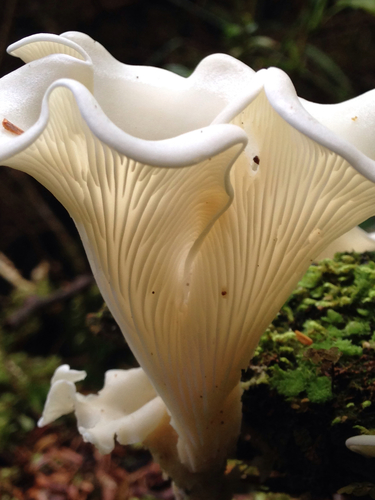
Pleurocybella porrigens is a mushroom species whose fruit bodies are pure white when young, and may turn yellow as they age. The cap is typically 4–9 centimetres (1+1⁄2–3+1⁄2 inches) wide, with a petal or fan shape. The stipe is either very short or entirely absent, the flesh has a faint, pleasant scent, and the gills are crowded, becoming decurrent when a stipe is present. Compared to oyster mushrooms of the genus Pleurotus, the flesh of this species is thin and fragile. It produces a white spore print. This species is widespread across temperate forests of the Northern Hemisphere, and can be found in North America from August to November. It is a white-rot wood-decay fungus that grows on conifer wood, most commonly on hemlock from the genus Tsuga. Pleurocybella porrigens was once generally considered edible, though it had a bland flavor. As of 2011, it is linked to two separate outbreaks of fatal encephalopathy in Japan. Most people affected in these outbreaks had preexisting kidney disorders. The first outbreak took place in September and October 2004 across nine prefectures in Japan, where 59 people became ill and 17 eventually died. Most of the people who died had preexisting liver problems, the average age of affected people was 70, and death occurred between 13 and 29 days after symptom onset; symptoms developed no more than three weeks after consuming the fungus. The second outbreak happened in 2009, when a 65-year-old man on hemodialysis died from acute encephalopathy after eating Pleurocybella porrigens. The mechanism behind the species' toxicity has not been definitively confirmed, though multiple possible mechanisms have been proposed. Cell culture studies have shown that Pleurocybella porrigens contains an unusual amino acid that is toxic to rat brain cells, but researchers have not yet been able to definitively confirm this amino acid as the cause of the fatal encephalopathies. Other proposed mechanisms for the apparent toxicity include the possibility that the fungus contains toxic levels of cyanide salts.