About Pleurobranchus areolatus Mörch, 1863
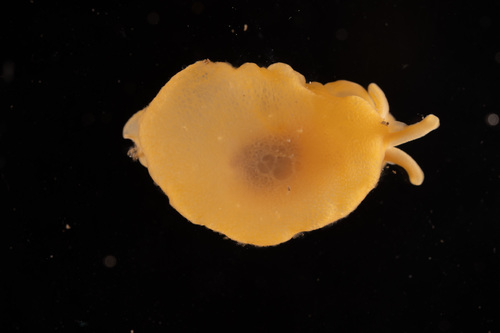
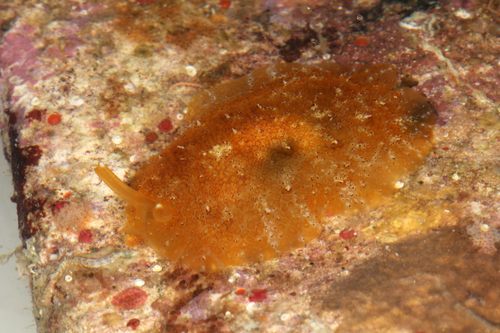
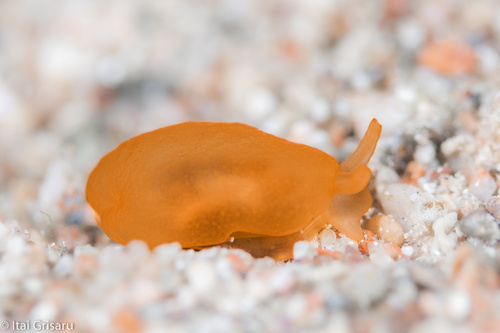
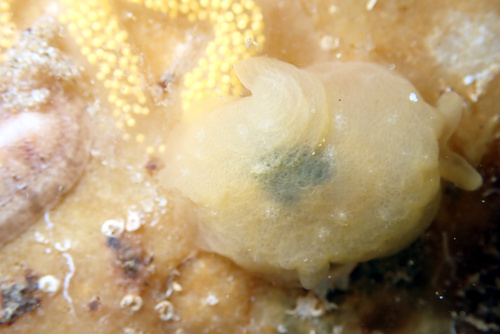
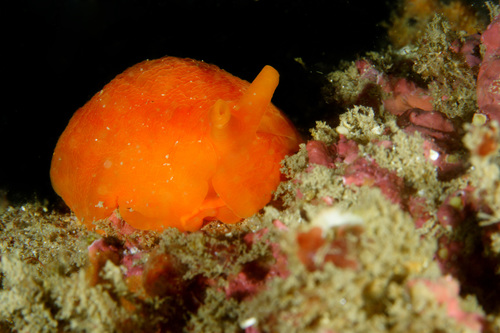
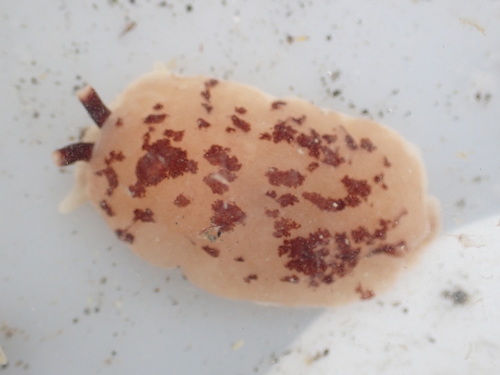
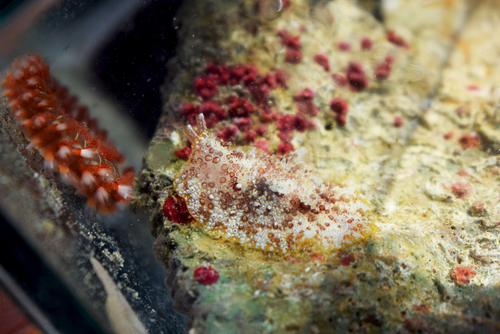
Pleurobranchus areolatus Mörch, 1863 has an oval-shaped body. Its dorsum bears numerous small, polygonal, flat tubercles. The body's background color ranges from light brown to deep violet, with varying amounts of opaque white pigment present on the tubercles. In some individuals, this opaque white pigment is arranged in a symmetrical pattern across the body. The species can reach up to 150 mm in total length. Its rhinophores are rolled, fused at the base, and marked with horizontal striations running from the base to the tip. The rhinophores share the same color pattern as the rest of the body. In some preserved specimens, a clearly visible well-marked pedal gland can be seen at the posterior end of the foot. Like all other species in the genus Pleurobranchus, this species has a reduced, internal shell. The shell itself is not useful for reliable species identification within the genus Pleurobranchus, and is oval in shape. Its protoconch has one whorl and measures approximately 400 μm in size. Up-to-date illustrations of the reproductive system of this species were published by Goodheart et al. (2015) and Alvim & Pimenta (2016). The genital cup is located just before the gill on the right side of the body. The reproductive system is triaulic, meaning it has two female openings and one male opening. The prostate is elongated, with a rounded frontal portion. The radula follows the formula 73 × 115.0.115, with no central tooth and 115 lateral teeth on each side; smaller 27 mm long specimens have been recorded with a radular formula of 66 × 90.0.90. In living 27 mm long specimens, the gill reaches two-thirds the length of the entire body. Alvim & Pimenta published a detailed description of the circulatory system in 2016, noting it matches the circulatory system of Pleurobranchus reticulatus. The same authors also described the nervous system of P. areolatus, which is very similar to that of P. reticulatus. Pleurobranchus areolatus is distributed off the coasts of Mexico, Costa Rica, Venezuela, Brazil, Jamaica, Puerto Rico, St. Thomas, Aruba, St. Maarten/St Martin, the Bahamas, Bermuda, Panama, the Canary Islands and Madeira. It was the only species of Pleurobranchus recognized to occur in the Caribbean Sea until 2016, when Pleurobranchus iouspi was reported from Santa Marta, Colombia. Its type locality is Saint Thomas, U.S. Virgin Islands. While P. areolatus was previously reported from the eastern Pacific, these records were reclassified as Pleurobranchus digueti in 2015. This species was recorded as abundant in Biscayne Bay, Florida in 1946. Its recorded depth ranges from 0 m to 70 m. It is typically found under rocks and coral rubble; in Florida, it is sometimes found living among colonies of Porites porites corals. In Florida, individuals of this species lay large, translucent, gelatinous egg masses during the spring. All species in the genus Pleurobranchus are carnivorous, and P. areolatus is thought to probably feed on ascidians, including Didemnum sp. Its known ectoparasites include the copepod Anthessius ovalipes. Rodriguesic acids and their esters, which are modified diketopiperazines, were isolated from P. areolatus in 2014. This marked the first time diketopiperazine derivatives had been isolated from a mollusc. Similar diketopiperazines have also been isolated from the ascidian Didemnum sp. These compounds may originate from a symbiont living with P. areolatus, or may be acquired from the ascidians the species feeds on. P. areolatus may use these chemical compounds as a form of chemical defense.