About Pleurobranchaea maculata (Quoy & Gaimard, 1832)
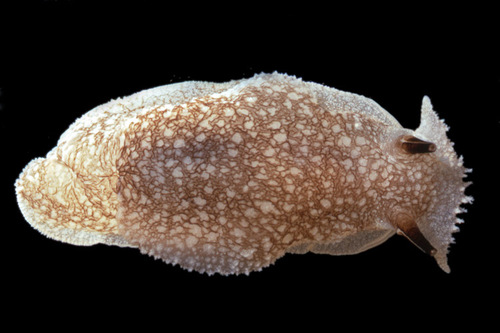
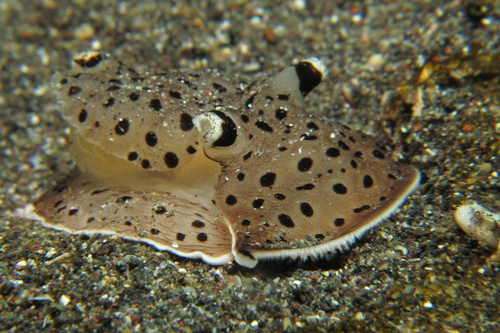
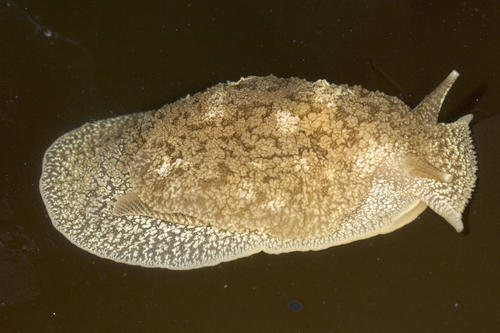
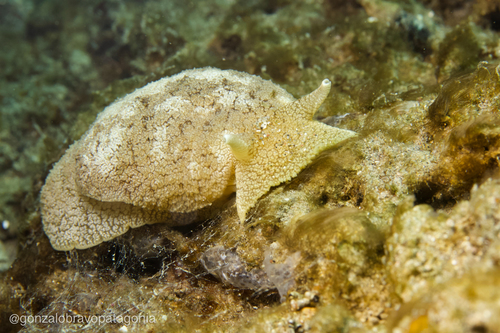
Pleurobranchaea maculata (Quoy & Gaimard, 1832), a species of marine side-gill slug, typically measures 80 to 100 mm in length, and specimens found further south tend to be somewhat larger. Its body is mottled pale grey, densely patterned with short, broken brown lines. It has a wedge-shaped head with two sensory tentacles called rhinophores. The mantle has a smooth texture but is covered in folds and puckers, and the foot extends well past the mantle. This species retains no remnant of a shell, and its feathery gill is tucked under the right side of the mantle. The native range of this species includes New Zealand (encompassing coasts around the North Island and South Island), southeastern Australia, China, Sri Lanka, and Japan. In 2009, it was reported far outside its native range on the coast of Argentina, after which it spread rapidly, and currently occupies approximately 2,000 km of the southwestern Atlantic coast. This side-gill slug occurs intertidally in harbours, and can be found at depths of up to 6 m or deeper off rocky coasts. It is often washed ashore during spring storms. It is an opportunistic carnivore that feeds on other soft-bodied invertebrates; it especially preys on sea anemones, but will also consume marine worms, mussels, dead or dying animals, and other Pleurobranchaea sea slugs. Pleurobranchaea maculata produces small eggs that hatch after approximately one week. The newly hatched individuals become planktotrophic larvae that remain in this stage for three weeks before settling. This species lives for 2–3 years and dies after spawning in winter. In 2009, a major public scare occurred in the Auckland Region of New Zealand after several dogs died of tetrodotoxin poisoning following consumption of Pleurobranchaea maculata found on local beaches. Children and pet owners were advised to avoid affected beaches, and recreational fishing was interrupted for a period. Exhaustive analysis concluded that the affected sea slugs had most likely ingested tetrodotoxin while feeding on dead fish, and no similar poisoning events have occurred since.