About Pleurobrachia pileus (O.F.Müller, 1776)
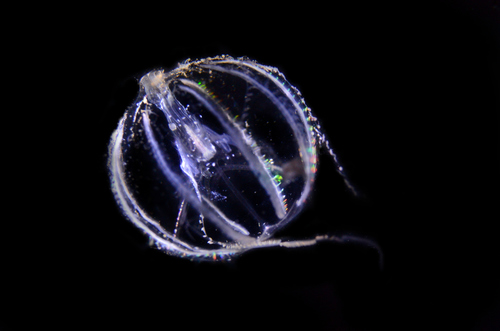
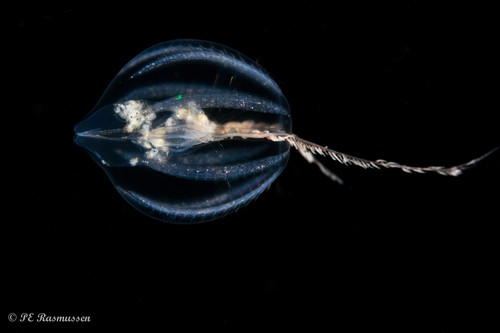
Pleurobrachia pileus is a small comb jelly with a globular or ovoid body, reaching up to around 2.5 cm (1 inch) in length. It has one pair of long tentacles used for catching prey, which can be retracted into protective sheaths. These tentacles can grow up to twenty times the length of the jelly's body, and are fringed with filaments along one edge. The body has four pairs of longitudinal rows of cilia called combs, which extend about three-quarters of the animal's length between its mouth and its opposite aboral end. Synchronized beating of these cilia allows the animal to swim, and produces an iridescent appearance. The body itself is transparent, while the comb rows are milky white. The tentacles, sheaths, and pharynx are also milky white, though some individuals have a dull orange coloration.
Pleurobrachia pileus is found in the northern Atlantic Ocean, along the northwestern coasts of Europe, and off the eastern Atlantic coasts of North America. It also occurs in the Baltic Sea, Skagerrak, Kattegat, North Sea, and Black Sea. This pelagic species lives primarily in open water, but it can sometimes be found in rock pools or washed up on beaches. It is common around European coasts during early summer. Populations in the Baltic Sea rely on inflows of saline water from the North Sea to persist.
Pleurobrachia pileus is a predatory species that feeds on actively swimming prey, including gammarid amphipods, crab zoeal larvae, barnacle cyprid larvae, and calanoid copepods. Across most of its range, it lives alongside another comb jelly species, Bolinopsis infundibulum, and the two species do not compete for food because they have different feeding habits. P. pileus stays motionless to snare larger prey with its long tentacles, while B. infundibulum pulls in a feeding current of water and filters out smaller, slower-swimming tiny zooplankton.
In the North Sea, P. pileus and its main copepod prey perform large daily vertical migrations. The jellies spend the night in upper waters, usually just below the thermocline, descend to deep water between 80 and 150 metres (260 and 490 feet) in early morning, and rise back to upper waters in late afternoon. These migrations do not occur in winter; during this season, P. pileus stays close to the seabed sediment, and often stops moving its comb cilia. This change in behaviour may be caused by the scarcity of prey in the water column during winter. When P. pileus is on or near the sediment, it is preyed upon by crustaceans including the hermit crab Pagurus bernhardus, the shore crab Carcinus maenas, and the common shrimp Crangon crangon.