About Pleurobrachia bachei A.Agassiz, 1860
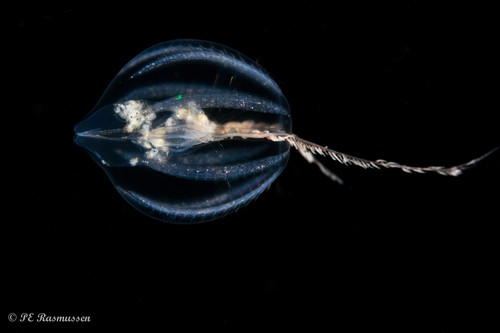
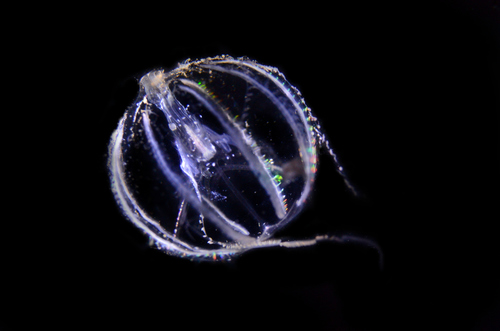
Pleurobrachia bachei A.Agassiz, 1860, commonly called sea gooseberry, has a body that can grow up to 20 mm (0.79 in) long, and each of its two tentacles can stretch to 150 mm (5.9 in). Its gelatinous, globular body is made of 99% water. It has eight rows of well-developed comb plates, which are formed from thousands of fused macrocilia and controlled by an apical organ. Unlike most other ctenophores, this species does not have a conventional photoprotein, so it cannot produce light. Its body is nearly transparent, and the many cilia it holds refract light to create rainbow-like colors, which can falsely look like bioluminescence. Its branched tentacles can be white, yellow, pink, or orange. Pleurobrachia bachei has no nematocysts (stinging cells). Instead, its two long, extensile branched tentacles are covered in colloblasts, which are specialized adhesive cells that help the species catch prey. Its mitochondrial genome only contains 12 genes. This ctenophore is found along the West coast of North America, ranging from Southeast Alaska to Mexico. It lives primarily in surface waters of the coastal Northwest Pacific, from within 5 km of shore down to around 50 m deep; during the day, it is usually found in the upper 15 m of the water column. Pleurobrachia bachei has no sessile (attached) life stages, and is entirely planktonic throughout its whole life cycle. It is a self-fertile hermaphrodite that releases eggs and sperm freely into the sea. Embryos develop without any parental protection, and development is indirect.