About Plethodon yonahlossee Dunn, 1917
Plethodon yonahlossee (described by Dunn in 1917) is a large woodland salamander from the Southern Appalachians, distinguished by its large size and distinctive rust-toned back. Like all species in the genus Plethodon, it is lungless and a direct developer: there is no larval stage, and young hatch as miniature adults. Fully metamorphosed adults have a nasolabial groove that helps with chemoreception.
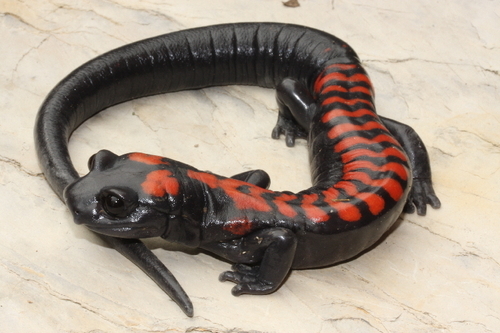
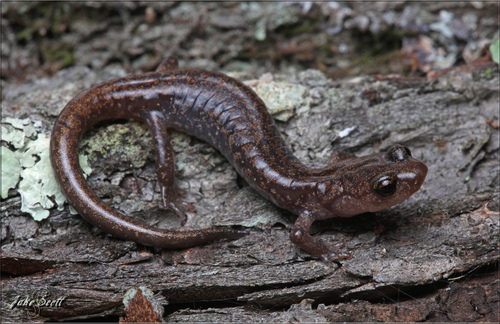
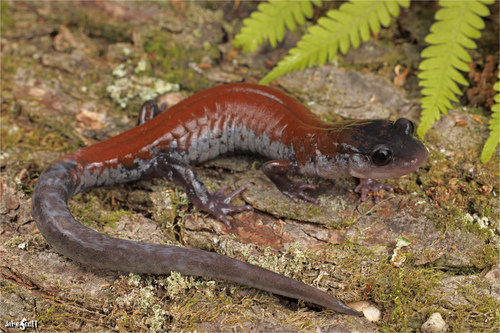
This salamander has a black base color on its back, covered in reddish-brown to red blotches that change with age: juveniles are typically more spotted, while older individuals have reddish blotches that merge into a wide band running the full length of the back. Its body sides have grey to white blotching, the top of its head is solid black, and the belly and throat are pigmented, sometimes with a blotched pattern similar to the back.
P. yonahlossee is the largest species of the Plethodontidae family in North America. Females are significantly larger than males, and typical adult length ranges from 11 to 22 cm. Most individuals have 15 or 16 costal grooves.
This species is distributed in the southern Blue Ridge Mountains across northern Tennessee, western North Carolina, and small parts of southwest Virginia. Specific recorded locations include Avery, Yancey, and Rutherford Counties in North Carolina; Rocky Fork State Park and Limestone Cove in Unicoi County, Tennessee; and Whitetop Mountain, Virginia. It lives in a variety of upland wooded habitats, most commonly deciduous forests at elevations between 437 and 1,737 m, and is more altitudinally restricted than other plethodontid species. It is often found in damp, shaded spots on wooded hillsides and ravines, where rock slides are covered in moss and ferns; in areas with old windfalls; and in grassy areas near woodlands.
A unique population in Bat Cave, Rutherford County, North Carolina, often occurs in rock crevices. This population is sometimes recognized as a separate species, P. longicrus, distinguished by different coloration and limb morphology. Bat Cave variants can have prominent, patchy, or even no red color on the back, with dark sides and light spots; their overall coloration is much darker than standard P. yonahlossee, and some scientists still classify them as a separate species. Unlike standard P. yonahlossee, this variant reaches sexual maturity based on size rather than age: males must be larger than 65 mm, and females larger than 61 mm, to be mature.
During the day, P. yonahlossee shelters under rotting logs, rocks, or in burrows under logs on the forest floor; it is debated whether the salamanders create these burrows or just reuse partially filled, eroded passages. They prefer old windfall logs that have shed most of their bark, with logs larger than 25 cm in diameter, no more than 5 to 15 cm of the log below the ground surface, and a thick layer of leaf litter at the interface between the log and the ground. They are active on humid or rainy nights, and will even cross roads in suitable habitat.
Little is known about the reproductive habits of P. yonahlossee. Reproduction occurs on land, and eggs are laid in underground cavities. Like other species in the genus, the female may guard the eggs until they hatch. Spermatogenesis most likely happens after the salamanders emerge from hibernation. Courtship is assumed to occur in early August, as pairs of salamanders have been found sharing the same shelter at this time, and males have noticeably enlarged mental glands. Females lay eggs in late August or early September. Clutch size depends on female size, and typically ranges from 19 to 27. Sexual maturity is thought to occur at around three years of age for standard P. yonahlossee, and a confirmed marker of maturity is the length of the mental glands: around 56 mm in mature males, and 60 to 66 mm in mature females, varying with female size.
Both adults and juveniles forage at night. Juveniles are most active one hour after sunset, while adult activity peaks one to two hours later. All age classes are carnivorous, eating small insects and invertebrates including mites, spiders, millipedes, centipedes, and earthworms.
Predators are likely snakes, birds, and small mammals. To avoid predation, P. yonahlossee produces noxious secretions from its tail that deter birds and other mammals. After initial contact with a threat, it becomes immobile, making it harder for visual predators to detect and increasing its chance of survival. In laboratory settings, P. yonahlossee has been observed to aggressively defend its territories. Like most species in the genus, it undergoes vertical underground migration, moving underground to stay through cold winters.