About Plethodon welleri Walker, 1931
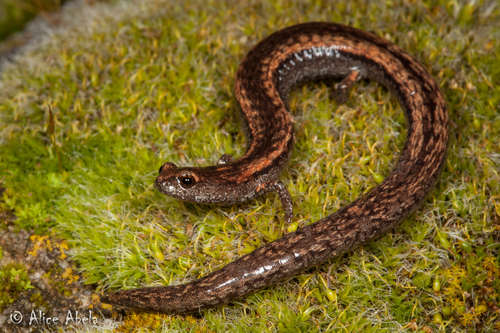
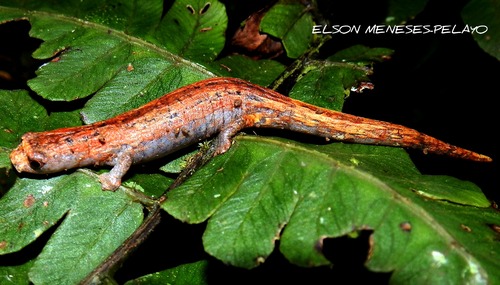
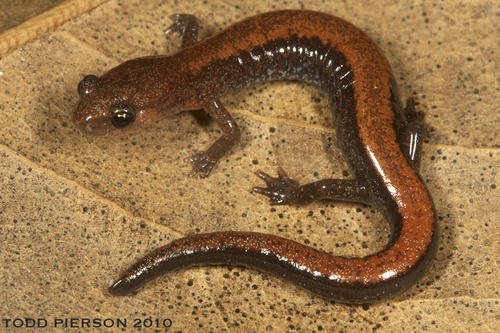
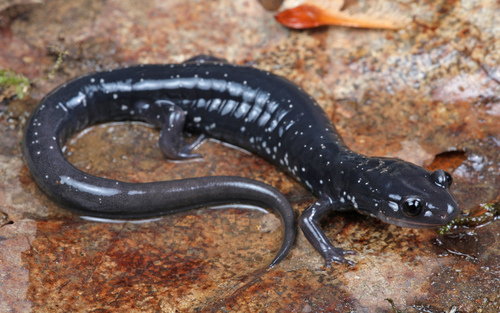
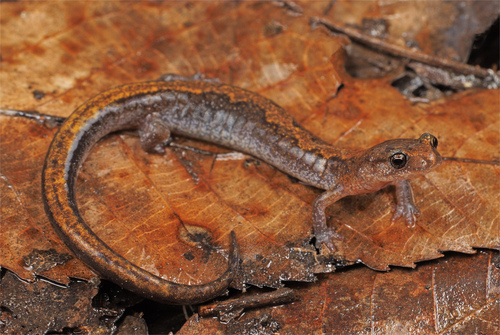
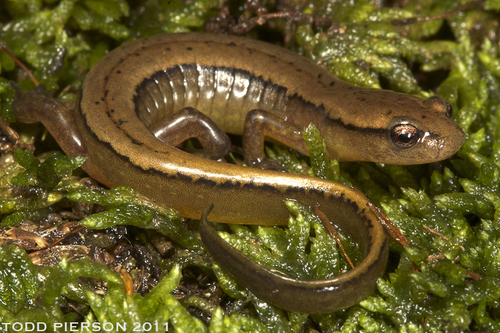
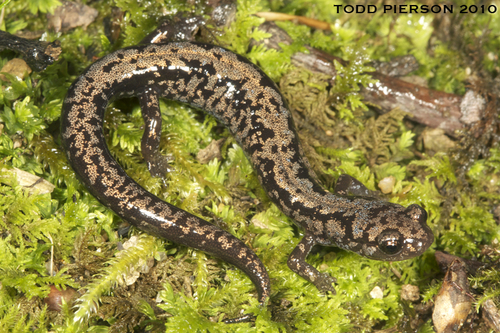
Weller's salamander (Plethodon welleri) has 16 costal grooves and light dorsal markings, which are typically dark gold with a metallic sheen. It is a small, slender-bodied salamander, like most plethodontids. This species has 17 trunk vertebrae, making it the shortest of the eastern small plethodontids, and has two to seven series-arranged vomerin teeth. It also has webbed toes. Males and females can be differentiated by visible genitalia: females have a simple slit, while males have a cloacal gland and papillae in the vent. This plethodon salamander is a high-altitude species native to the southern Blue Ridge Mountains. Its range covers northwest North Carolina, and parts of Tennessee and Virginia that the mountain range extends into, but it is only found in a small number of counties across these states: Johnson and Unicoi Counties in Tennessee, and Yancey County in North Carolina. It also inhabits mountain areas including Mt. Rodgers and the Whitetop Mountains in southwest Virginia, and the Unaka Mountain ridges in northeastern Tennessee and eastern North Carolina, and occurs mainly in the highland areas around this mountain ridge. It lives in heavily shaded spruce and birch forests, though some individuals have been found in upper-level hardwood forests. It prefers cooler temperature habitats, and is most often found under logs, stones, and flat rocks. Weller's salamanders breed in spring and fall, and courtship behavior has been observed in captivity during October and April. Females reach reproductive maturity when they are 35 mm long, typically when they are over 3 years old. Males are able to breed when they reach around 30 mm in length, at approximately 2 to 3 years old. Females lay clutches of 4 to 11 eggs in tight clusters suspended by a stalk. Nests are located under moss mats covering conifer logs. Eggs are observed between mid-August and September, and measure between 2.6 and 6.5 mm in diameter. Offspring undergo direct development, with little to no visible gills once hatching occurs. There is some evidence that females brood or guard their eggs; females found at these nests were undernourished, which suggests they do not feed while guarding eggs. The eggs females lay are dark in color, due to pigmentation from melanophores.