About Plethodon websteri Highton, 1979
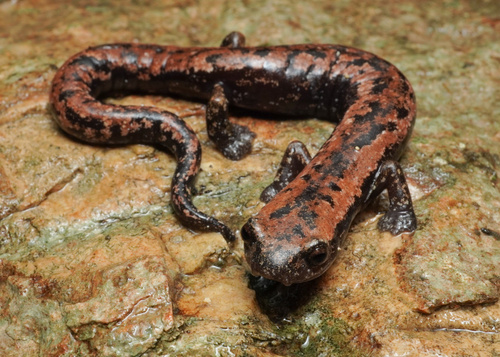
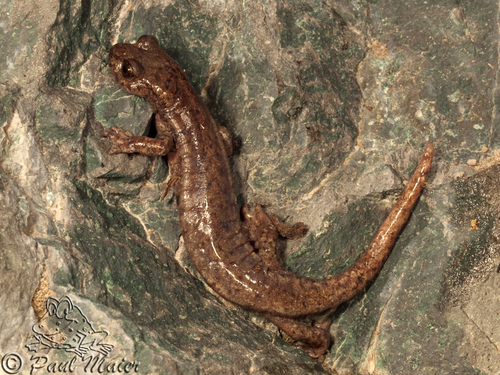
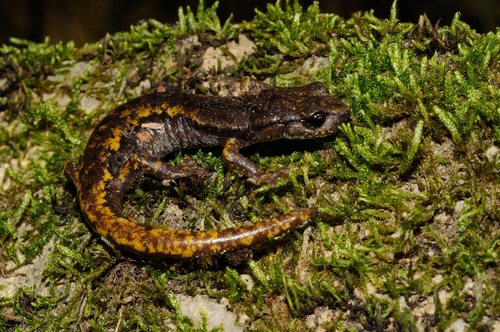
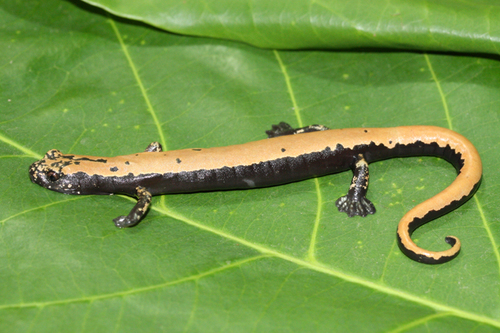
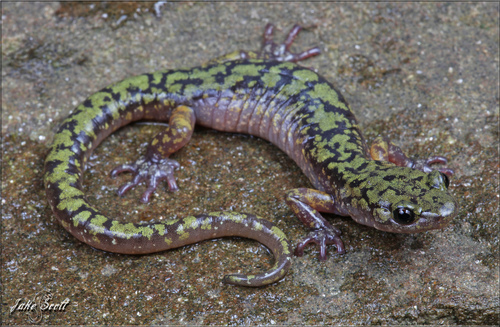
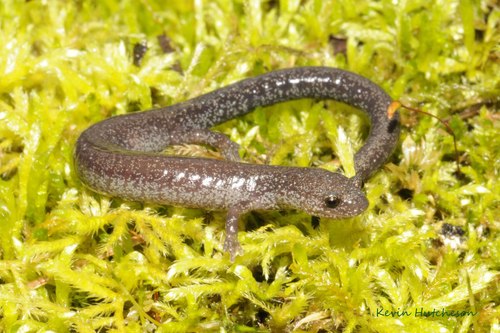
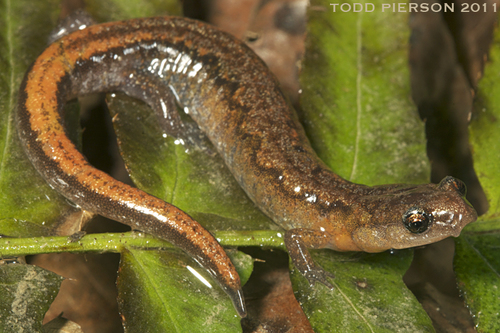
Webster's salamander, scientifically Plethodon websteri Highton, 1979, is a cryptic species that is nearly impossible to tell apart morphologically from several other eastern Plethodon species. These similar species include the red-backed salamanders P. cinereus and P. serratus, and the zigzag salamanders P. angusticlavius, P. dorsalis, and P. ventralis. Like these related species, Webster's salamander is a small plethodontid that displays a wide range of color patterns over a dark brown base background. Its back often has a red, orange, or yellow dorsal stripe that may have irregular edges, though the species can also be completely unstriped. When a dorsal stripe is present, it is typically brighter on the tail than on the torso. The flanks and underside of the salamander are speckled with white, red, and black. Webster's salamander is mainly distinguished from similar species by genetic data and its geographic range, which mostly does not overlap with these similar species. It does have some sympatric overlap with the southern zigzag salamander (P. ventralis) in northern Alabama. While the two species can be confused with each other in this overlapping area, they never hybridize. Where they co-occur, P. websteri usually occurs as a striped morph, while P. ventralis usually occurs as an unstriped morph. P. websteri and P. ventralis have subtle but measurable differences in head shape, and these differences do not appear to be related to their diet or broader climate conditions. Variation in head shape is strongest between different populations of each species, and has no correlation with how much sympatry each population experiences. Competition-induced character displacement is unlikely to be the cause of these morphological differences, though microclimate preferences are a possible, yet still unstudied, factor. For its ecology, individuals of Webster's salamander forage on the forest floor from late October to early May. Activity levels and observation rates reach their peak during the winter. Individuals can be easily found sheltering under logs even on dry winter days, while no individuals have been observed at all during the summer, regardless of weather conditions. Juveniles remain active slightly longer than adults, but even juveniles disappear by June. Based on the biology of collected males, the breeding season is most likely January to March. While oviposition has not been directly observed, the species is an annual breeder with direct development, just like other Plethodon species. Females produce a clutch size of 3 to 8 eggs, most commonly 5 or 6. The eggs are presumably laid during the summer, and hatch into fully terrestrial young shortly after laying. This clutch size is among the smallest recorded for any plethodontid, and this small clutch size is probably a consequence of the species' small adult body size. Most of the species' growth occurs during its active foraging months of October to May, and the average age of sexual maturity is estimated to be around 2 years. It is generally assumed that individuals shelter underground during the inhospitable summer months, and drift fence experiments have revealed details of this seasonal movement. As warmer months approach, the salamanders travel on humid nights toward rock outcrops and crevasses. These features give the salamanders access to cooler, moister underground refuges to escape summer heat. These cooler areas act as dens for brooding females, newly hatched juveniles, and any other sheltering individuals. Deep natural refuges are particularly important for this species. Webster's salamander is among the southernmost members of the genus Plethodon, and its small, fragile build means it likely has poor burrowing ability. A few more northern plethodontids with similar body shapes, such as the eastern red-backed salamander P. cinereus, are also known to move into burrows for summer aestivation. P. cinereus mostly relies on soil disturbances and burrows created by other animals, but these burrows are often too warm and shallow to work as effective summer refuges for Webster's salamander. Small individual Webster's salamanders feed primarily on mites and springtails. Larger individuals switch to larger prey such as ants, and some will feed on large quantities of termites when termites are available. This feeding pattern matches the diet of southern red-backed salamanders (Plethodon serratus) of the same size range.