About Plethodon shenandoah Highton & Worthington, 1967
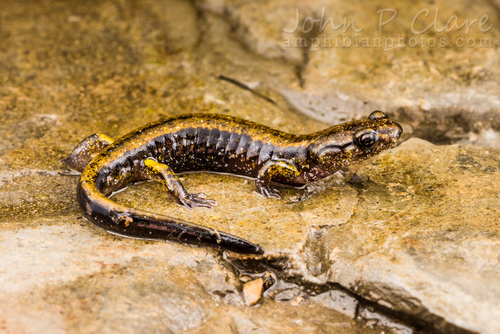
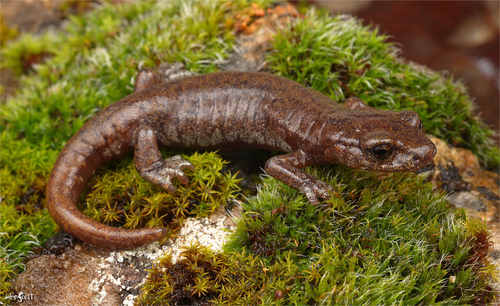
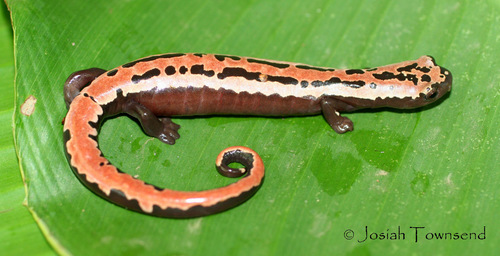
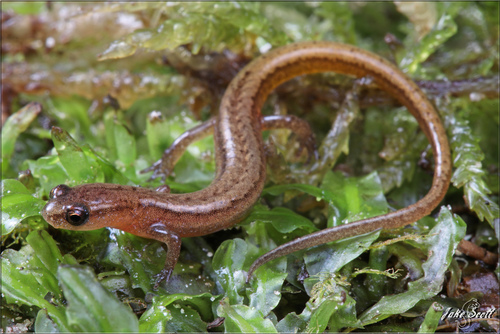
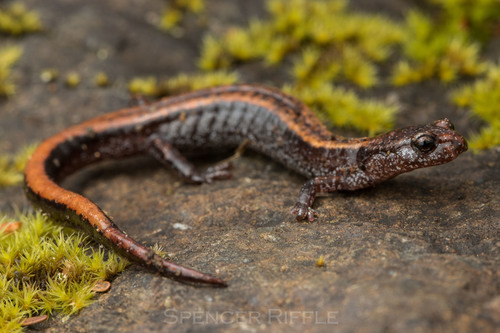
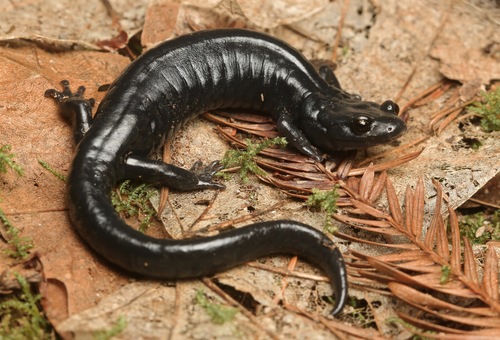
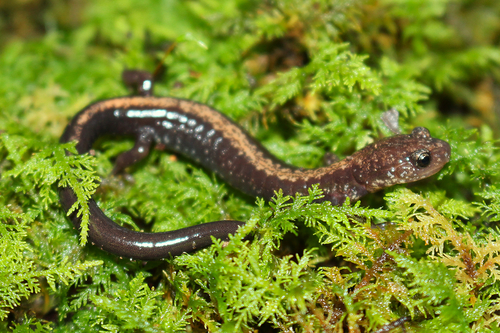
Description: The adult Shenandoah salamander (Plethodon shenandoah Highton & Worthington, 1967) is a slender, moderate-sized lungless salamander, with a total length of 3.5 to 4.5 inches (7 cm - 10 cm). It belongs to the family Plethodontidae, meaning it breathes through its skin instead of having lungs; because respiration depends on maintaining skin moisture, this restricts its body size and requires it to live in moist environments like forested areas. This species has two distinct color phases: striped and unstriped. The striped phase has a narrow red-to-yellow colored stripe running down the center of its back, while the unstriped phase is uniformly dark with occasional scattered brass-colored flecks. Both color phases have white or yellow spots along the sides of the body. The Shenandoah salamander is visually similar to the closely related red-backed salamander (Plethodon cinereus), but the two can be distinguished by several features: the stripe of the Shenandoah salamander only covers one-third of its dorsal area, while the red-backed salamander's wider stripe covers approximately two-thirds of its back; the Shenandoah salamander lacks the characteristic "salt and pepper" underside color pattern of P. cinereus; and it also has a slightly larger, more broadly rounded head than the red-backed salamander. This species is primarily nocturnal: it hunts for food at night, and shelters in dark, damp locations such as rock crevices and under logs during the day. Habitat range: The Shenandoah salamander is thought to have originated in the Appalachians of eastern North America, and historical population abundance of this species is unknown. Currently, the species is only found on the north-facing talus slopes of three mountains (Hawksbill, The Pinnacles, and Stony Man) within Shenandoah National Park in Virginia. Each of these three talus slopes holds an isolated population of the salamanders, located around 3,000 feet above sea level. These talus slopes are typically dry, so Shenandoah salamanders are generally found within moist microhabitats scattered across the talus environment. Although these dry talus slopes are not optimal habitat, competition with the red-backed salamander excludes the Shenandoah salamander from the optimal forested areas with deep, moist soil. Critical habitat: In 2015, the Center for Biological Diversity submitted a petition to designate critical habitat for nine species including the Shenandoah salamander. The Center requested that the U.S. Fish and Wildlife Service designate 16,891 acres within Shenandoah National Park as critical habitat for the species. As the Shenandoah salamander requires very specific habitat conditions and is restricted to high-elevation mountains in Virginia, it faces growing threats from climate change, invasive species, pollution, and human activity. Designating the proposed area as critical habitat would address potentially incompatible Park Service management practices, and would benefit the conservation of this salamander species.