About Plethodon ocmulgee Highton, 1989
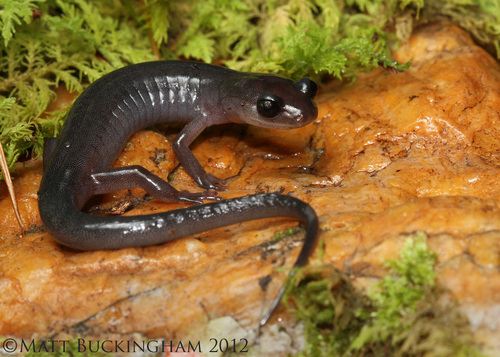
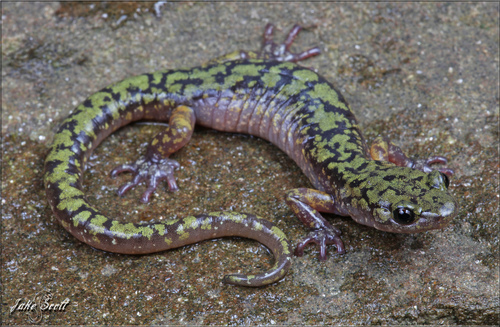
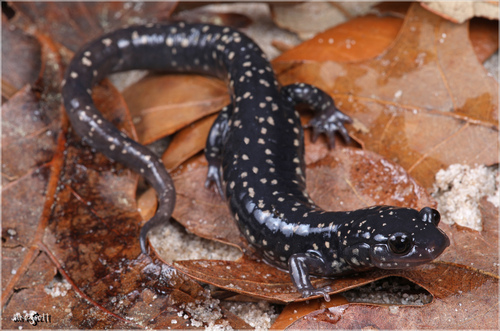
The Ocmulgee slimy salamander (Plethodon ocmulgee Highton, 1989) is primarily black, with white or yellow circular markings spread across its body; these markings become more dense on the underside. Its limbs are usually slightly lighter in color than its torso, and adults typically reach a total length of 4.5 to 7.0 inches (11.4 to 20.3 cm), including the tail. Like all lungless salamanders, this species has four toes on each forelimb and five toes on each hindlimb. The group of slimy salamanders gets its name from a slimy, sometimes sticky secretion produced by its skin glands. As lungless salamanders, Ocmulgee slimy salamanders breathe through their skin and the mucous membranes in their throats, so they must stay moist to survive. Even with this requirement, they do not have an aquatic larval stage; they hatch from terrestrial eggs and are immediately able to move once they emerge. This species is only found in counties surrounding the Ocmulgee River drainage basin, mostly in the lower section of the basin in the coastal plains of southern Georgia. Ocmulgee slimy salamanders have also been observed in counties surrounding the Altamaha River, of which the Ocmulgee is the westernmost tributary. When sexually mature, male Ocmulgee slimy salamanders develop a distinct mental gland on the underside of their chin. This gland produces hormones to stimulate female interest, and males rub the gland on females to spread these hormones. Females can be easily identified by their bulging abdomens, which are caused by developing eggs. After breeding, females lay a clutch of eggs in an appropriate moist, sheltered location and guard the eggs until they hatch. Eggs usually hatch after an average of three months, and juveniles look like small versions of adults, with no aquatic larval stage. Ocmulgee slimy salamanders take approximately two years to reach full sexual maturity.