About Plethodon nettingi Green, 1938
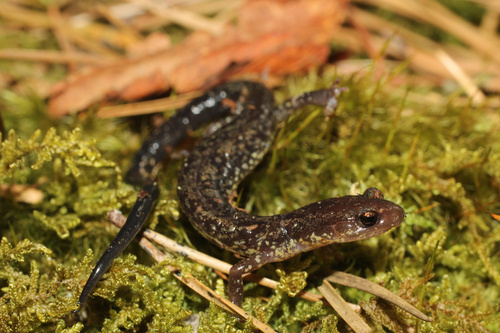
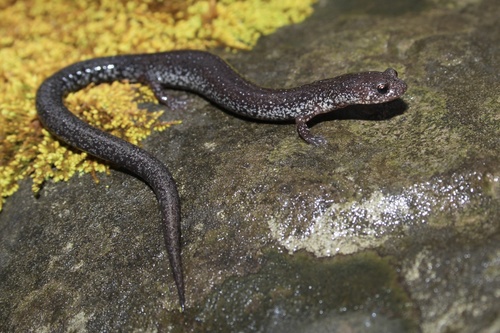
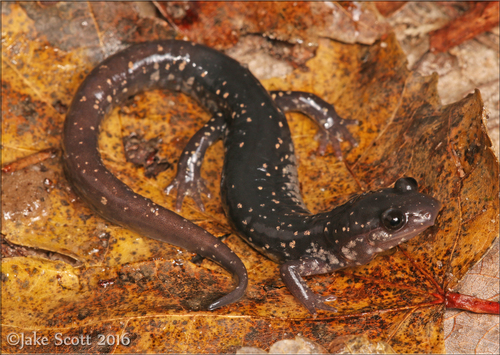
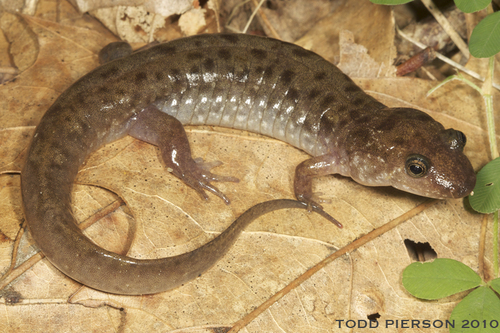
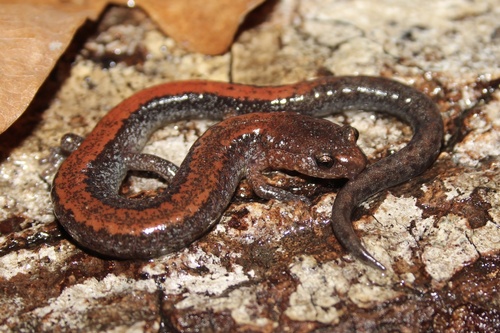
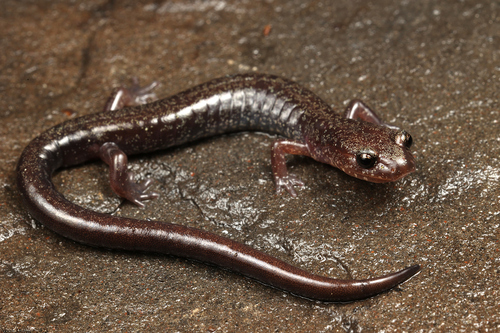
The Cheat Mountain salamander (Plethodon nettingi Green, 1938) is a small salamander similar in size to the red-backed salamander, with a total adult length (including the tail) of 3 to 4¾ inches (7½ to 12 cm). It can be distinguished by its solid black or dark brown back, which is heavily marked with many small brassy, silver, or white flecks, and it lacks a dorsal stripe. Its belly is dark gray to black, and its tail is roughly the same length as its body. Its body has 17 to 19 vertical costal grooves along its sides. This species is restricted to a small area of the high Allegheny Mountains in eastern West Virginia. In the 1930s and 1940s, its known range was limited to Cheat Mountain above 3,500 feet (1,100 m) elevation in Randolph County, and to Thorny Flat, Cheat Mountain's highest point, in Pocahontas County. Surveys done in the 1970s and 1980s expanded the known range to include Pendleton and Tucker Counties, including locations like Backbone Mountain and Dolly Sods. More recent surveys have added the eastern edge of Grant County to its range, where populations occur as low as 2,640 feet (800 m) elevation. Most populations are still found above 3,500 feet (1,100 m) elevation. The entire range of P. nettingi covers only around 935 square miles (2,420 km²), and populations are not continuous across this area; around 60 isolated populations are known. Much of the species' range falls within the Monongahela National Forest. Originally, the Cheat Mountain salamander was most likely restricted to red spruce forests on West Virginia's higher mountains. Most of these original forests were logged by 1920, so many current populations live in mixed deciduous forests that replaced the original red spruce stands. These mixed forests include tree species such as yellow birch, American beech, sugar maple, striped maple, and eastern hemlock. The species is not dependent on any specific vegetation type, but it is often associated with boulder fields, rock outcrops, or steep shaded ravines with dense rhododendron growth. It is more abundant near large emergent rocks, where soil and leaf litter are cooler and more moist than on surrounding hillsides. These rocky refugia likely protected the salamanders when original forests were cleared and in some cases burned. Cheat Mountain salamanders are typically found in areas with ground cover of bryophytes (including mosses and liverworts, especially the liverwort Bazzania), plus abundant leaf litter, fallen logs, and sticks. Breeding behavior of P. nettingi has not been directly observed, but breeding most likely occurs on the forest floor. Male-female pairs have been found together under rocks in both spring and autumn, and during these months both sexes are in breeding condition: males have swollen cloacas and squared-off snouts, while females carry mature follicles. Nesting behavior is similar to that of the red-backed salamander. Females typically lay 8 to 10 eggs, with a recorded minimum of 4 and maximum of 17. Eggs are attached to the inside of rotten logs or the underside of rocks or logs, in both red spruce and deciduous forests. Females have been found guarding small egg clusters from late April through early September. The female guards the eggs until they hatch, a common behavior for salamanders in the woodland salamander family Plethodontidae. Young salamanders complete their larval development inside the egg, so when they hatch in late August or September they already resemble small adults. Juveniles reach sexual maturity at 3 to 4 years old, and individuals live for approximately 20 years. Young salamanders may stay in the same area as adults until they reach maturity, at which point they disperse to establish their own territories. Individual territories are around 48 square feet (4.5 m²) in area. Woodland salamanders rarely leave their territories, so individuals only move a few meters over their entire lifespan.