About Plethodon cinereus (Green, 1818)
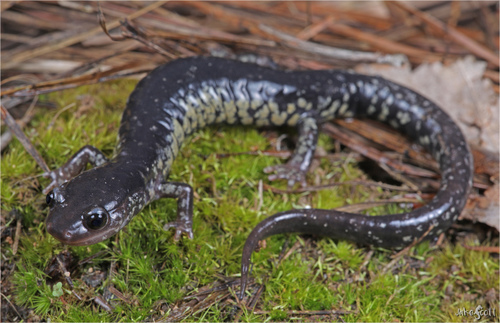
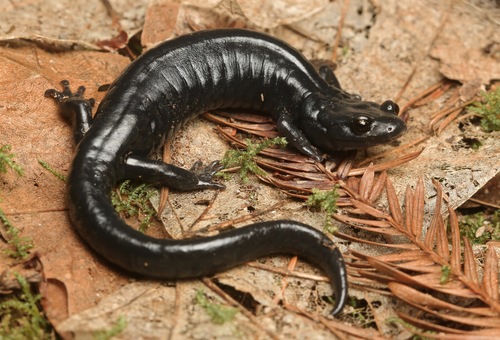
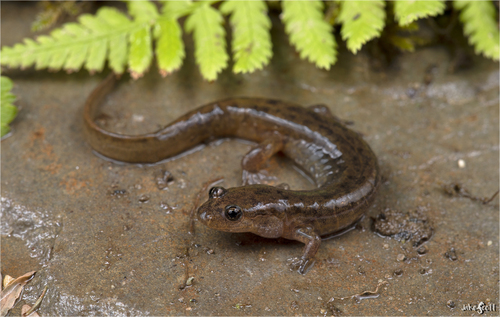
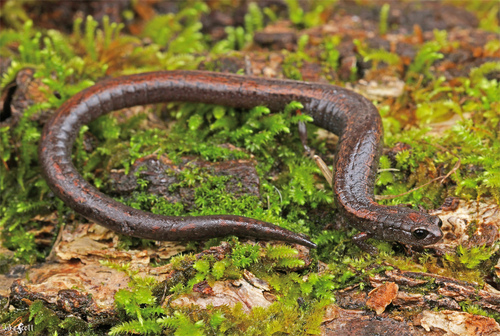
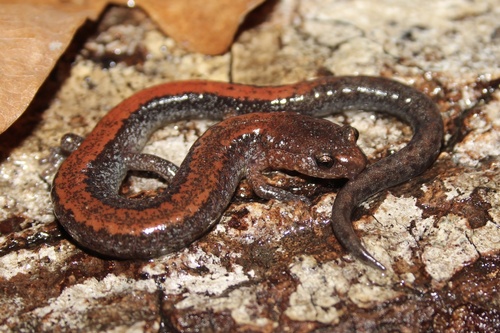
Plethodon cinereus, commonly called the red-backed salamander, is a small terrestrial salamander that reaches a total length of 5.7–10.0 cm (2.2–3.9 in) including the tail. It typically inhabits forested areas, where it lives under rocks, logs, bark, and other debris, and is one of the most abundant salamander species across its entire range. Like all amphibians, red-backed salamanders have permeable skin. As members of the family Plethodontidae, they lack lungs, an ancestral trait for this group, so they rely entirely on cutaneous respiration for gas exchange. Because their permeable skin is prone to desiccation and must stay moist to enable cutaneous respiration, most of the species’ ecology and behavior is constrained by climatic and microclimatic variables, especially dryness and temperature. The skin of red-backed salamanders hosts the epibiotic bacterium Lysobacter gummosus, which produces the chemical 2,4-diacetylphloroglucinol that inhibits the growth of certain pathogenic fungi. Red-backed salamanders live in close contact with forest floor soil, and soil pH strongly influences their population density and distribution. While acid deposition accelerates soil acidification in maturing deciduous forests, which can limit the distribution of amphibians and populations of related species, P. cinereus prefers to occupy more neutral soils over acidic soils. The species is rarely found in soils with a pH of 3.7, and occurs more frequently in soils with a pH of approximately 3.8 or higher. Juvenile P. cinereus have never been recorded in soils with a pH lower than 3.7, and laboratory studies have supported these observations. A pH between 2.5 and 3 causes acute mortality in P. cinereus, while a pH between 3 and 4 causes chronic mortality. Low soil pH also reduces the species’ growth and respiration. Slower growth and delayed metamorphosis make juvenile P. cinereus more vulnerable to predators, which creates major risks for population survival. Moisture and temperature are other factors that affect the species’ population density and distribution. During prolonged dry periods, individual salamanders move deeper into the soil; during short dry periods, they retreat under logs or rocks. They avoid very warm areas, and retreat underground when temperatures drop to 4–5 degrees Celsius. Their preferred optimum temperature range is 10 to 15 degrees Celsius. Both intraspecific and interspecific competition also shape the species’ distribution. When surface conditions are too dry or hot to be hospitable, red-backed salamanders stay within moist microhabitats — under rocks, woody debris, or within the soil — for extended periods to maintain hydration. They only come to the surface for short periods to travel, forage, or reproduce. The length of time they can remain active on the surface is directly limited by their rate of cutaneous water loss to the environment, which is affected by environmental factors including altitude, forest canopy cover, and the amount of recent precipitation. The spatial distribution of Plethodon cinereus follows seasonal patterns. Compared to other seasons, in spring red-backed salamanders are more likely to gather in groups of 2 to 7 individuals under cover objects such as rocks and wood, while overall population density on the forest floor remains constant. This grouping pattern occurs because territorial spatial disputes begin in spring. A study conducted on Blackrock Mountain, Virginia found that the mean number of salamanders per 100*100 m quadrat ranged from 1.6 to 3 in spring, compared to 0.8 to 1.8 in summer. The increased spread of individual salamanders across the landscape from spring to summer is attributed to intraspecific interference competition. Cover objects on the ground provide good moist refuges for P. cinereus during the rainy season. Because red-backed salamanders cannot forage underground, they are restricted to areas under and around these cover objects. Observed spacing patterns are driven by aggression and territoriality when resources such as food and shelter are limited. This species has two distinct color morphs with different standard metabolic rates; lead-phase P. cinereus prefer warmer habitats and microclimates. This provides strong evidence that the geographic distribution of color morphs in the species is shaped by selection on physiological traits. Like many species in the genus Plethodon, Plethodon cinereus exhibits homing behavior. Females return to their nests, and both non-attending females and males return to their established home ranges. Homing ensures females maintain necessary contact with their eggs to support egg survival, and allows non-attending females and males to travel outside their home range to escape predation pressure, search for food or cover, and return if they do not find a more favorable microhabitat. Male red-backed salamanders actively defend their territories from intrusion by other males, and are less aggressive towards invading females and juveniles. Red-backed salamanders typically show aggressive behavior towards both conspecifics and heterospecifics that they identify as potential competitors, and they interact positively with both conspecifics and other potential competitors such as centipedes. A visual stimulus is required to trigger the species’ threat posture; if only chemical cues are present, red-backed salamanders do not show obvious aggressive behavior towards conspecifics or heterospecifics. In experimental tests where male P. cinereus were individually exposed to four substrate chemical cue treatments (control, self, conspecific, or centipede (Scolopocryptops sexspinosus)) to test their behavioral response to conspecific and heterospecific cues, males increased the time they spent in aggressive postures when paired with centipedes, but did not show increased aggression when paired with conspecifics. An individual’s residency status also affects its level of aggression, but regardless of residency status, red-backed salamanders will attack centipedes. For reproduction, male and female P. cinereus usually establish separate feeding and/or mating territories under rocks and logs. However, some red-backed salamanders are thought to practice social monogamy, and may maintain co-defended territories throughout their active periods. Breeding takes place in June and July. Females produce 4 to 17 eggs per year. Eggs hatch 6 to 8 weeks after being laid. Little is known about neonate dispersal, but both neonates and juveniles are thought to be philopatric. Like many species in the genus Plethodon, female red-backed salamanders can store sperm as spermatophores, and have been documented storing sperm for up to eight months before the June and July oviposition period. No sperm or spermatophores are retained after oviposition is complete.