About Plestiodon skiltonianus Baird & Girard, 1852
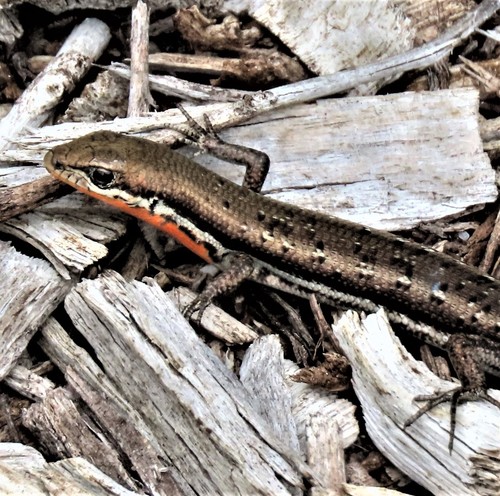
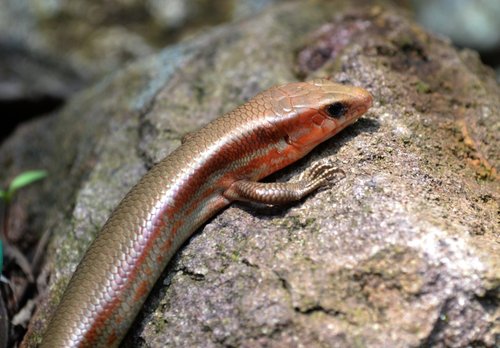
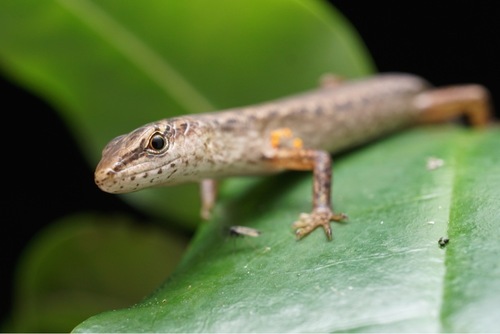
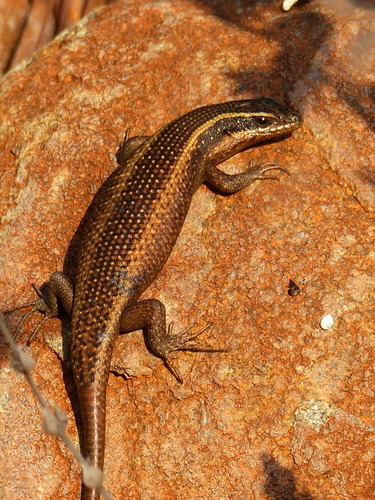
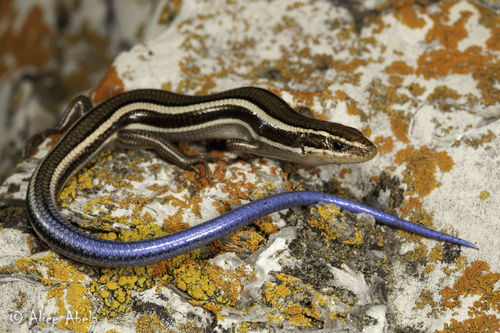
Adult western skinks (Plestiodon skiltonianus) have a broad brown stripe running down their back. This stripe is edged with black, and each side is bordered by a prominent whitish to beige dorsolateral stripe that starts on the nose, extends over the eye, and continues along the side of the body onto the tail. A second pale stripe starts on the upper jaw and runs low on each side of the body. This stripe is separated from the first dorsolateral stripe by a broad dark brown or black band that originates on the side of the head and usually extends well onto the tail; however, this band can become disrupted if the tail is lost and regrown. Juvenile western skinks have bright blue tails, which fade to grey as they reach adulthood. During the breeding season, reddish or orange color develops on the sides of the head and chin, and occasionally on the sides, tip, and underside of the tail. This species usually has seven supralabial scales and four enlarged nuchal scales. The coloration of young skinks is more vivid than that of adults. Western skinks occur in a variety of habitats ranging from sea level up to at least 2,130 m (7,000 ft). They are most common in early successional stages or open areas within these habitats, and generally avoid heavy brush and densely forested areas. They prefer a somewhat moist environment, but can also be found on dry hillsides. They frequent grassland, broken chaparral, pinon-juniper woodland, juniper-sage woodland, open pine-oak forests, and open pine forests. The soil of their nest chambers is always moist, and standing water is apparently not required. Although they avoid dense closed forests, they can be found in dry open areas within larger forested regions. The distribution of Plestiodon skiltonianus extends from southern British Columbia, Canada, south to the tip of the Baja California Peninsula, and across most of the Great Basin to extreme northern Arizona, and from central Utah west to the Pacific Coast. The species is apparently absent from the floor of California’s San Joaquin Valley (though it has been observed in rural areas of southeast Lodi, California), the central Sierra Nevada (except for a few scattered, very common populations in the foothills), and California’s lowland deserts. In Baja California, the species occurs in the northwestern region at least as far south as Colonia Guerro, and in southern Baja it is found in the cape and Comondu regions, Santa Agueda, and San Francisco de la Sierra. It has also been observed on Santa Catalina Island, Los Coronados Islands, and Todos Santos Island off the coast of California.