About Plestiodon septentrionalis Baird, 1858
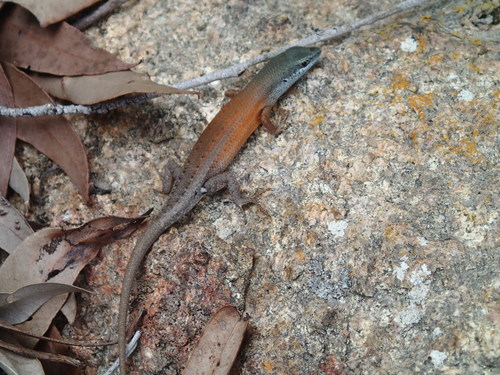
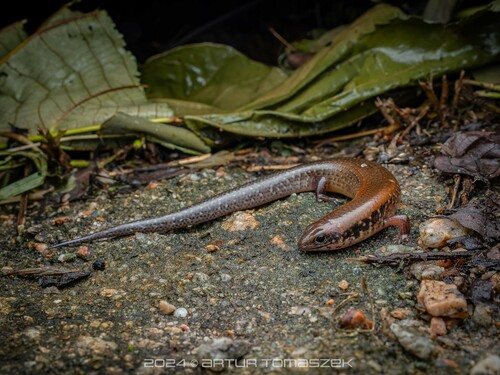
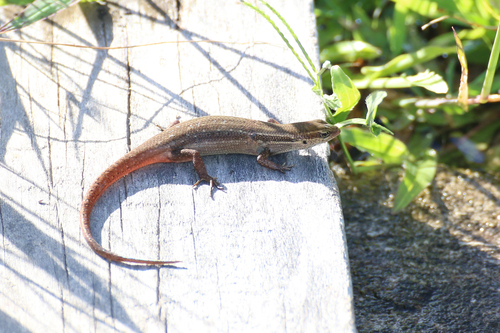
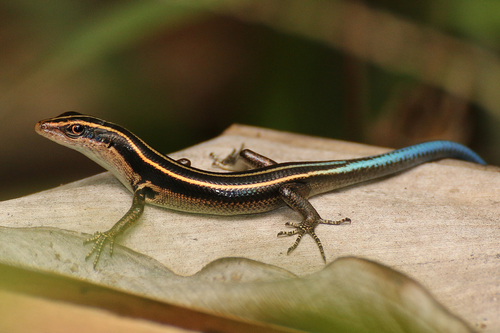
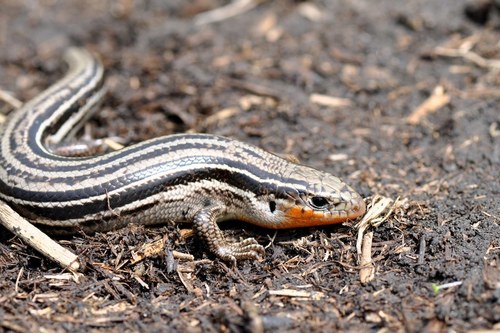
The prairie skink (scientific name Plestiodon septentrionalis Baird, 1858) is a small lizard that grows to a total combined body and tail length of approximately 13 to 22 cm (5 to nearly 9 inches). Adult prairie skinks have brown or tan dorsal coloration, darker sides, and multiple thin lighter stripes running along their back and sides. Juveniles have bright blue tails, and this blue color fades as the lizards reach maturity. Prairie skinks inhabit sandy areas or open grasslands with loose soil. They prefer sites that include some rocks for shelter and sun basking, and are located close to water sources. The two recognized subspecies of Plestiodon septentrionalis have separated, non-overlapping ranges. The northern subspecies ranges from eastern North Dakota and Minnesota southward to central Kansas. A small isolated population of the northern subspecies lives in southwestern Manitoba, Canada; this population is the only lizard found in Manitoba, and the species is one of only seven lizard species that occur in Canada, where the northern prairie skink is a protected taxon. The southern subspecies is found in Oklahoma and Texas. Prairie skinks hibernate from around September to late April each year. When they emerge in spring, males develop bright orange coloration on their jaws and throat to mark the start of the breeding season. After a gestation period of roughly 40 days, females lay between eight and ten eggs. The eggs hatch in August, and hatchlings measure approximately 5 cm (2.0 inches) long. Prairie skinks reach sexual maturity in their third year of life.