About Plestiodon reynoldsi (Stejneger, 1910)
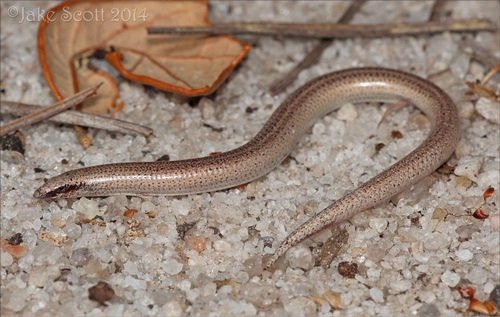
Plestiodon reynoldsi, commonly known as the Florida sand skink, is a unique lizard adapted to an underground lifestyle. It reaches a total length of 10 to 13 cm (4 to 5 in), and has a gray to tan body color. Its forelegs are very small, with only one toe on each, while its smaller hindlegs have two toes each. Approximately half of the lizard’s total length is made up by its tail. It has a wedge-shaped head, a partially countersunk lower jaw, body grooves that can hold its folded forelegs, and small eyes with transparent windows in the lower eyelids. All of these traits help the Florida sand skink move through loose sand. This species is only found in Central Florida, with 115 known sites recorded in 1999. It is hard to detect, so it may occur in other locations when more thorough searches are conducted. Confirmed populations are found on the Lake Wales Ridge, the Winter Haven Ridge in Polk County, and the Mount Dora Ridge. The Florida sand skink inhabits vegetated areas including sand pine–Florida rosemary scrub, longleaf pine–American turkey oak associations, and Florida scrub habitat. Food availability and moisture levels are key factors that determine whether the species can tolerate a habitat. Florida sand skinks are most often found in the ecotone between Florida rosemary scrub and palmetto-pine flatwoods, where moisture is present below surface litter and within the sand. The species is most active in spring, which is its mating season. Individuals reach sexual maturity between one and two years of age, and stay reproductively active for two to three years. Around 55 days after mating, a female lays approximately two eggs, which hatch in June or July.