About Plestiodon laticeps (Schneider, 1801)
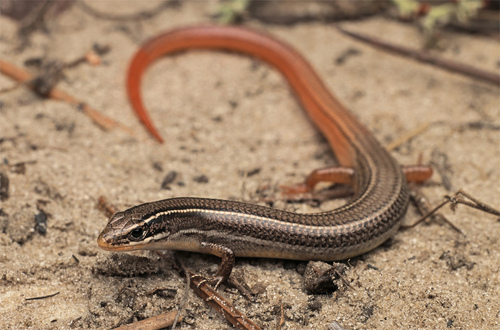
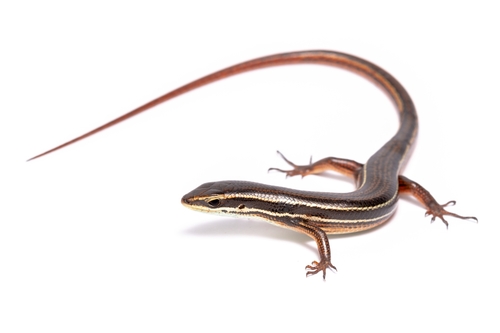
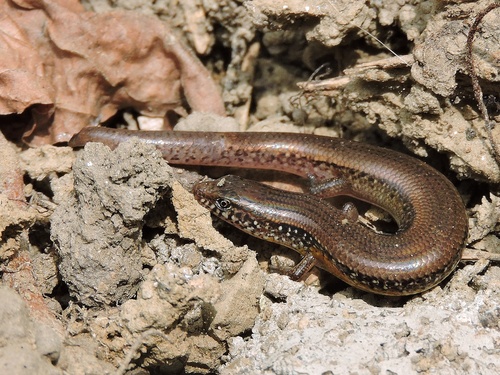
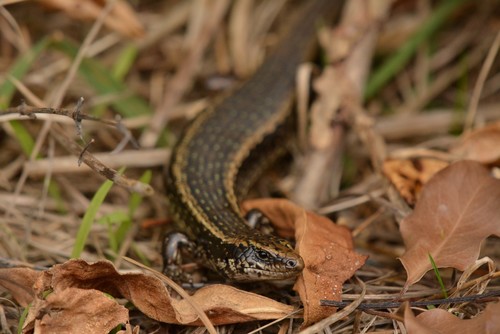
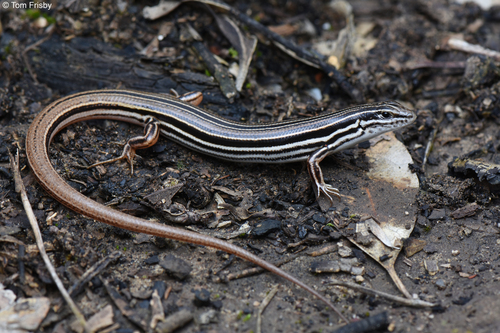
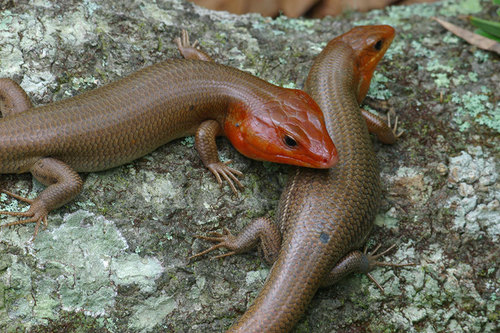
Plestiodon laticeps, commonly called the broad-headed skink, is among the largest "Plestiodon skinks" alongside the Great Plains skink. It grows to a total length between 15 cm (5.9 in) and nearly 33 cm (13 in). The species gets its common name from its wide jaws, which give the head a triangular shape. Adult males are brown or olive brown, and develop bright orange heads during the spring mating season. Females have five light stripes running down the back and tail, similar to the five-lined skink, but can be distinguished by having five labial scales around the mouth—five-lined skinks only have four. Unlike males, females may retain the blue tails they had as juveniles. Juveniles are black with five white or yellowish stripes (sometimes seven in eastern parts of the species' range) and a blue tail. Broad-headed skinks are semi-arboreal lizards strongly associated with live oak trees. They do not show a preference for specific tree sizes, but favor trees with holes. Juveniles stay closer to the ground, on low or fallen branches. Males have been observed guarding preferred trees surrounded by dense brush, which reduces predation risk and supports available prey. Dead and decaying trees are important habitat resources for nesting. Fallen logs are also essential, as small groups of broad-headed skinks gather in hibernacula underground or inside rotting logs to overwinter after the breeding season. The species' occurrence correlates with the presence of black walnut (Juglans nigra). The species is widely distributed across the southeastern United States, ranging from the East Coast west to Kansas and eastern Texas, and from Ohio south to the Gulf Coast. Males are typically larger than females. During breeding season, large males use aggressive behavior to guard females against other males, and pairs stay together for long periods to forage, bask,, and mate. Larger females lay more eggs, so males often seek out the largest available females, and sometimes fight severely with other males over access. In South Carolina, large adult males guard females within their territories and chase away smaller males. Females also prefer to mate with the largest males they can find, consistent with the Good Genes Hypothesis. When choosing mates, females prioritize male body size, and also favor the dominant trait of bright orange heads. Sexually receptive females emit a pheromone from glands at the base of their tail, and males track these chemical trails via tongue-flicking to locate females. Males have higher tongue flicking rates when exposed to conspecific females than to heterospecific females during mating, and will end interactions without initiating courtship if the pheromones do not match their species. Males can be particularly aggressive during mating season and maintain mate guarding for a large portion of the roughly two-week-long mating season. Mate guarding is costly for males: many suffer injuries or death while guarding their mate. When pregnant, females experience a 25% reduction in running speed and 50% reduction in endurance, so they shift to less active, less conspicuous behavior above ground to avoid predators. Females lay between 8 and 22 eggs, which they guard and protect until hatching in June or July. Females lay their clutches in cavities inside decaying logs, and have been observed creating nests by packing down debris within the cavities. Hatchlings have a total length of 6 cm (2.4 in) to 8 cm (3.1 in).