About Plestiodon gilberti (Van Denburgh, 1896)
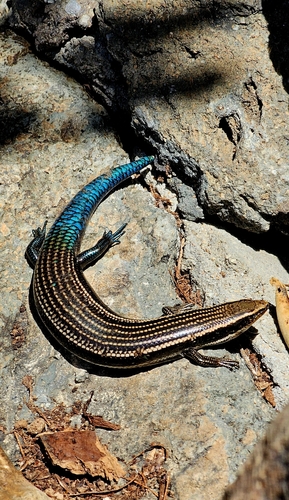
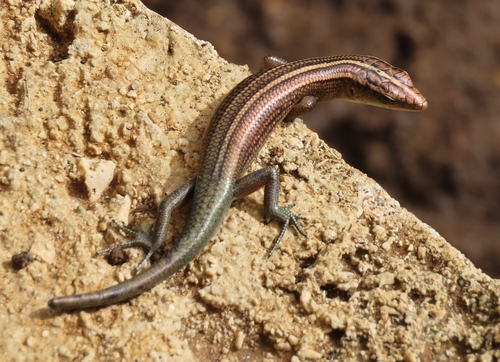
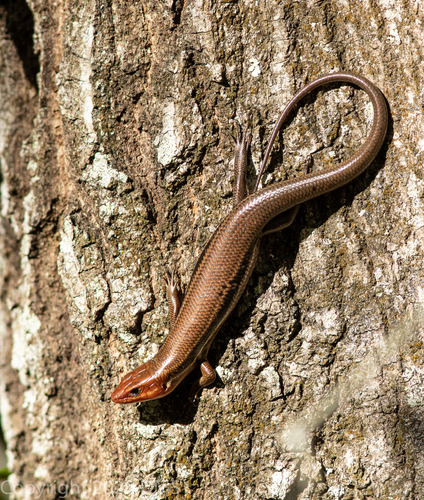
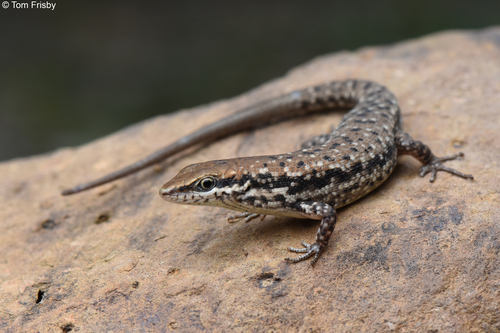
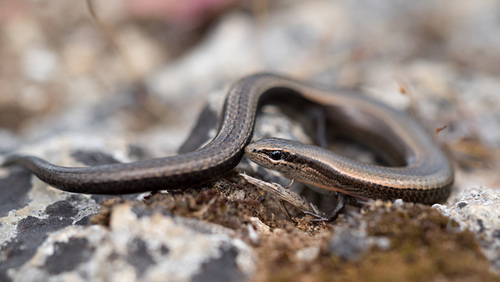
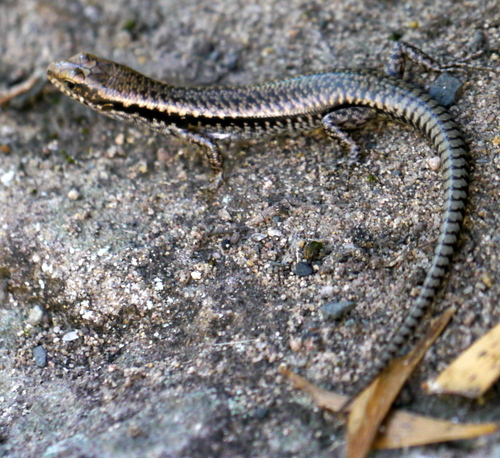
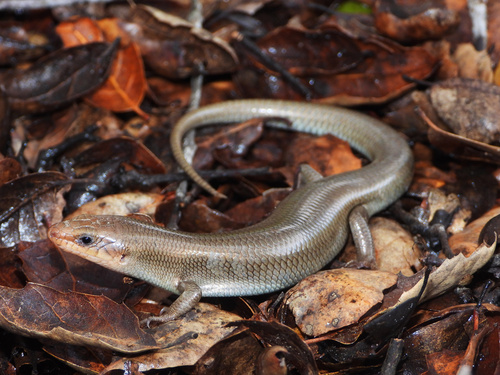
Gilbert's skink (Plestiodon gilberti) is a heavy-bodied lizard with small legs. Adult individuals are uniformly colored green, grey, olive, or brown. Juveniles have light stripes on their sides and back that enclose a broad black or brown stripe, and this dark stripe ends near the base of the waxy-pink tail. Juvenile striping fades as the lizard grows and matures, and this fading happens faster in males than in females. In some environments, Gilbert’s skinks look very similar to western skinks until they reach maturity. Gilbert's skink occurs mainly in California. Its range includes the northern San Joaquin Valley, the foothills of the Sierra Nevada from Butte County southward, the inner flanks of the Coast Ranges from San Francisco Bay to the Mexican border extending into northern Baja California, the mountains of southern California, and scattered mountain localities in the eastern desert from Mono County to San Bernardino County. It has been spotted in Kern County west of the Rand Mountains bordering San Bernardino, but larger populations are found east of this area, dispersed north of the Mojave Desert. Isolated populations are also present in western Arizona and southern Nevada. Gilbert's skink lives in habitats ranging from sea level to around 2,200 m (7,200 ft) in elevation. While it can be found in a wide variety of habitat types, it is most common in early successional stages or open areas within those habitats, which range from grassland to open chaparral or open pine forests. It generally avoids heavy brush and densely forested areas. The reproductive season for Plestiodon gilberti varies by location and from year to year depending on local conditions. Little is known about the exact timing of its reproduction, but it is thought to be similar to that of the Western Skink, which lays its eggs in June and July. Adult females build nest chambers several centimeters deep in loose moist soil, most often under flat stones. Clutch size ranges from 3 to 9 eggs.