About Plestiodon fasciatus (Linnaeus, 1758)
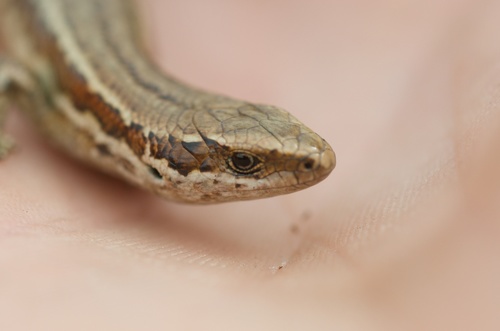
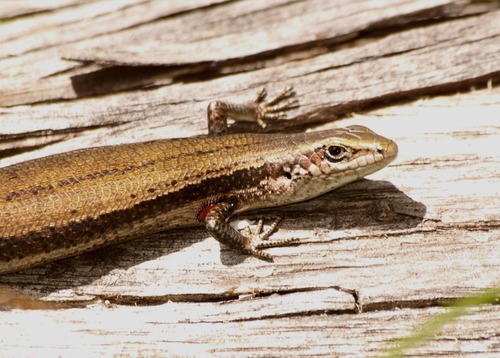
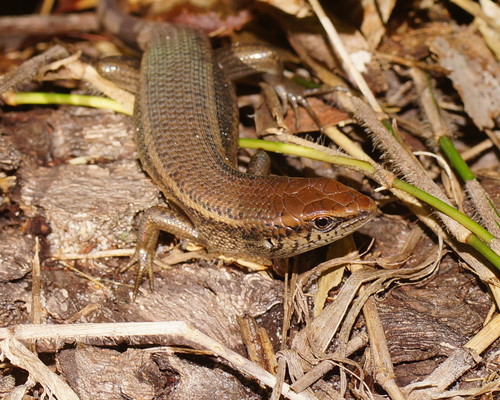
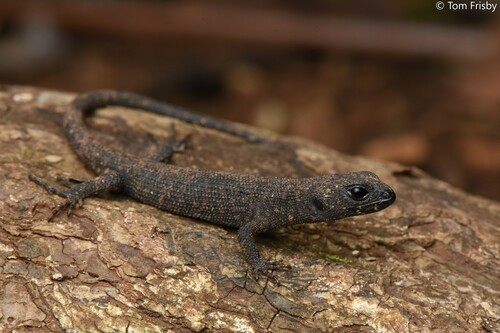
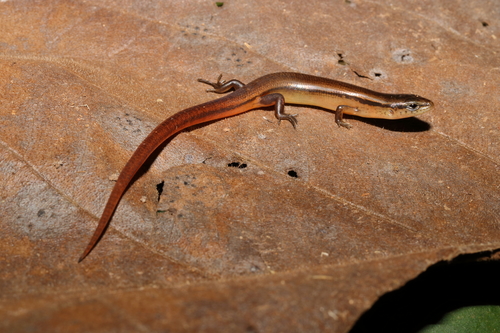
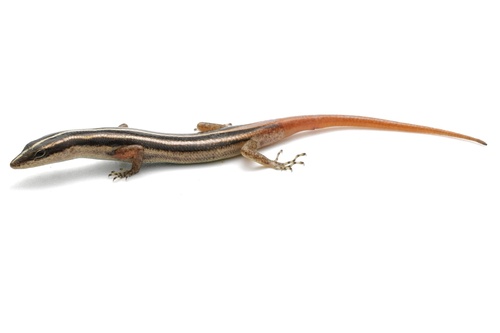
The American five-lined skink (Plestiodon fasciatus) is small to medium-sized, reaching a total length (including the tail) of about 12.5 to 21.5 centimetres (4.9 to 8.5 inches). Juveniles are dark brown to black, with five distinct white to yellowish stripes running along the body and a bright blue tail. The blue tail color fades to light blue as the skink ages, and the stripes may also slowly fade. Females are more likely to retain blue tail color into adulthood than males. The original dark brown base color also fades with age, and older individuals are often uniformly brownish.
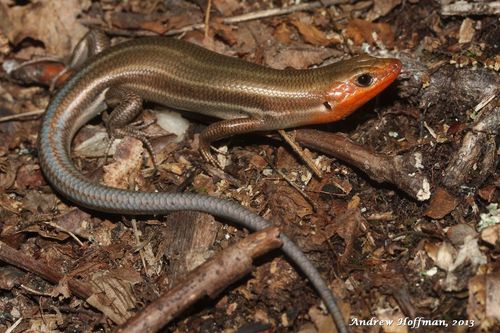
This species is very similar to the southeastern five-lined skink (Plestiodon inexpectatus), which is native to the Southeastern United States, and the two species have overlapping ranges; they can be told apart by differences in their scales. It is also similar to the broad-headed skink (Plestiodon laticeps), and distinguishing between them can be difficult. Broad-headed skinks usually lack the two enlarged postlabial scales that are characteristic of P. fasciatus. Adult male broad-headed skinks are easy to distinguish from P. fasciatus by their larger size and swollen red head. Research shows that P. fasciatus is sexually dimorphic in size, with males often larger than females, though this size difference depends on the region the skinks inhabit. P. fasciatus has short, downward-curving claws that form a right angle at the axis of each toe.
The geographic range of the American five-lined skink extends north to southern Ontario, Michigan, and eastern New York. Its western boundary runs through Minnesota, Missouri, eastern Kansas, Nebraska, Oklahoma, and continues through Texas, Louisiana, Mississippi, Tennessee, and Florida. The species is most abundant on the coastal plain of the southeastern United States and along the Gulf Coast. It has recently been observed in increasing numbers in the northern Chesapeake Bay Region of Maryland, especially along the shores of the Elk River, and in northern Virginia. It has also been recorded in northern South America, specifically Colombia.
The American five-lined skink is a ground-dwelling species that prefers moist hardwood habitats with a permanent water source (such as a river or stream) and sites for basking in the sun. At the northern edge of its range, it can also be found in broken, rocky areas; within this northern edge, skinks prefer areas with more than average rock cover in locations with few trees. Little is confirmed about the hibernation patterns of P. fasciatus, as the species is rarely seen during winter and the months immediately before and after it. Scientists assume that P. fasciatus shelters and becomes dormant under rocks, logs, or leaf litter in the hardwood habitats it inhabits. The species is tolerant of minor habitat disturbances, but removal of woody debris in its northern habitats can negatively affect populations.
Fertilization in the American five-lined skink is internal. Mating occurs in May, and females lay eggs between mid-May and July, at least one month after mating. Males are polygynous and mate with multiple females. Females lay eggs in June, and the eggs incubate for four to six weeks before the young hatch, meaning development happens outside the female's body after egg-laying. Fertilization takes place shortly after copulation; unlike many other lizard species, female P. fasciatus cannot store sperm between successive clutches. One study found that most clutches are sired by multiple males, with unequal paternity sharing among sires within clutches. Polyandry is a consistent part of this species' mating system.
Females lay 15 to 18 eggs in a small cavity they clear underneath a rotting log, stump, board, loose bark, rock, or an abandoned rodent burrow. Females prefer secluded nest sites in large, moderately decayed logs. Soil moisture is an important factor in nest site selection, as females choose areas with higher soil moisture than surrounding areas. The vertical depth of the nest changes with moisture levels: nests are dug deeper into the soil cavity at drier sites. Significant nesting aggregation occurs even when unused nest sites are abundant.
The eggs of the American five-lined skink are parchment-like, thin, and easily punctured, similar to eggs of many other reptiles. Freshly laid eggs range from spherical to oval in shape, with an average length of 1.3 cm (0.51 in). Eggs increase in size as they absorb water from the surrounding soil. Egg color changes over time, shifting from white to mottled tan after contact with the nest burrow. The incubation period ranges from 24 to 55 days, varying with fluctuations in environmental temperature. Females usually brood their eggs during incubation and will behave defensively to protect eggs from smaller predators. Parental care ends one to two days after hatching, when hatchlings leave the nest. Juvenile American five-lined skinks reach sexual maturity and begin reproducing within two to three years of hatching, and can live up to six years.