About Plesiastrea versipora (Lamarck, 1816)
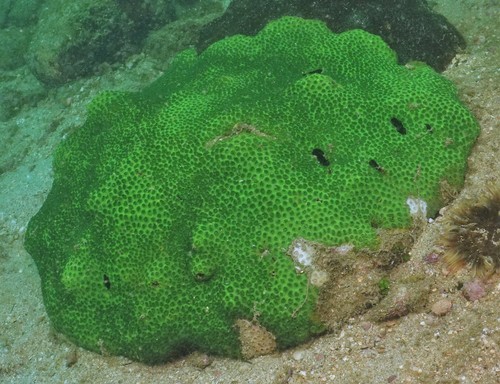
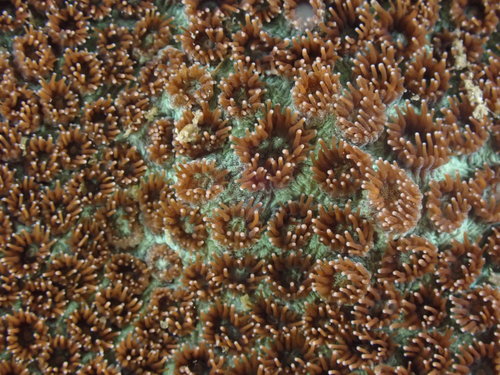
Plesiastrea versipora is an encrusting coral native to the Indian and Pacific Oceans. It draws scientific interest for its ability to thrive in both tropical and temperate environments, and to form massive growths. Existing massive colonies of P. versipora can be very long-lived, so analysis of their internal composition lets researchers reconstruct climatic records from past decades and centuries for the localities where these corals grow. As the only coral genus found in temperate waters that is capable of growing massive structures up to one metre thick, P. versipora is a valuable indicator for reconstructing climatic records of temperate seas. Plesiastrea versipora also serves as a model organism for studying communication between corals and their symbiotic zooxanthellae. Host-generated soluble compounds act as communication signals to the symbiont: these can either trigger the release of photosynthetic products (mainly glycerol) by the zooxanthellae, or inhibit photosynthesis. This phenomenon may potentially be generalized to other coral genera, since identical Symbiodinium strains often occur across multiple coral host genera. P. versipora is the type host for the newly described minor symbiont Chromera velia. Compared to the dominant, abundant Symbiodinium, C. velia is present in only small numbers in a host P. versipora colony, to the point that C. velia cells may be barely detectable in the host unless culturing is used. The host P. versipora reproduces sexually. Its larvae typically obtain symbiotic algae from the surrounding environment, though anecdotal evidence suggests some symbionts may also be transmitted via the eggs, meaning transmission may be mixed in this host species. This species displays a range of colors, which come from host pigments that protect the coral from ultraviolet radiation. Colonies of P. versipora often grow close to one another and come into contact. The broad range of color morphs found in P. versipora means it is often very easy to distinguish the boundary between one colony and another by their coloration.