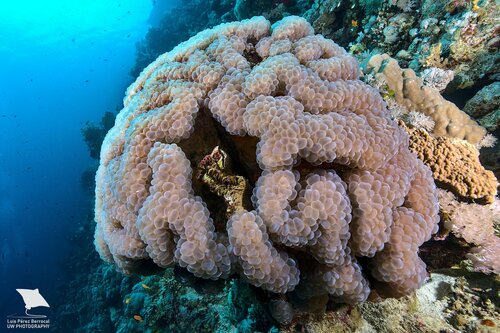
About Plerogyra sinuosa (Dana, 1846)
Colonies of Plerogyra sinuosa grow in an inverted cone shape, and can reach up to one metre (one yard) across. In small colonies, the corallites are monocentric and trochoid. As colonies grow larger, their corallites become flabellomeandroiid, meaning they are arranged in valleys where each adjacent valley has its own separate wall. The septa have smooth margins and are arranged irregularly. On young colonies, the costae sometimes form lobes that develop spines. These spines then elongate and a new polyp develops from them; this method of budding is unusual among corals. When the coral is alive, it produces vesicles that resemble bubbles, which grow up to 2.5 cm (1 inch) in diameter. These bubbles enlarge during the day, and retract partially at night to expose the polyps and their tentacles.

