About Pleopeltis polypodioides (L.) E.G.Andrews & Windham
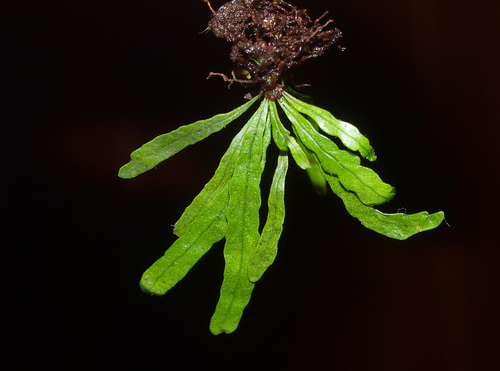
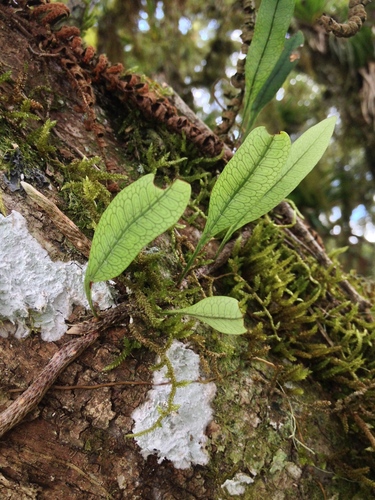
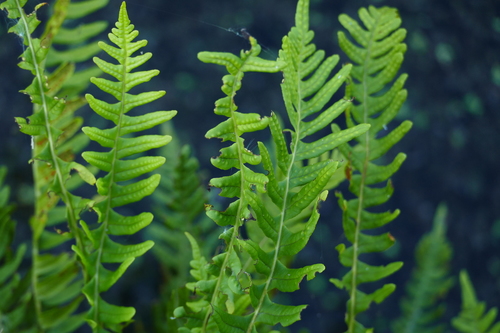
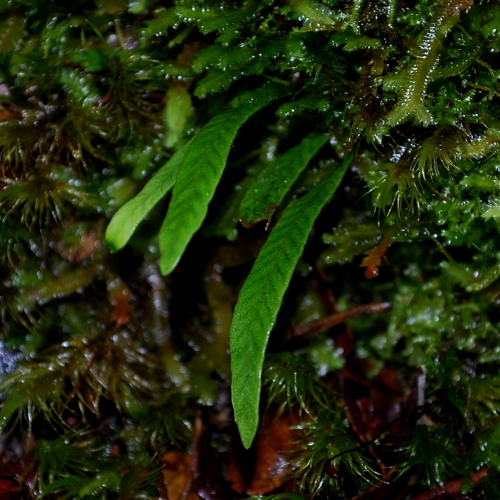
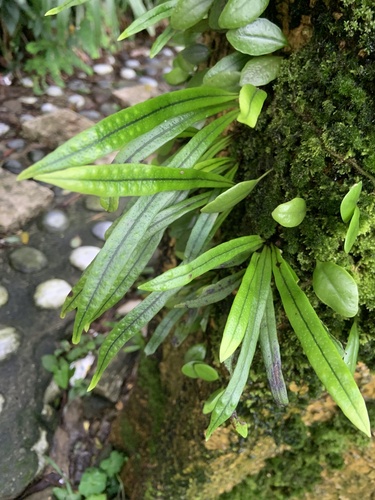
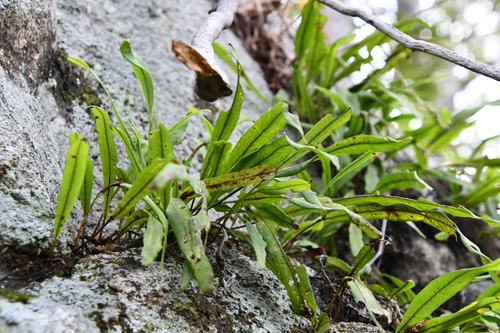
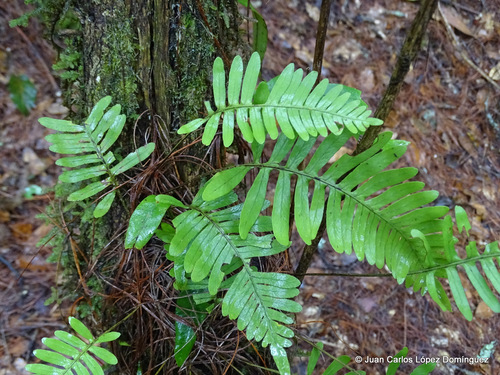
Pleopeltis polypodioides is an evergreen fern with monomorphic fronds that reach 25 cm in height and 5 cm in width. Its leathery, yellow-green leaflets (called pinnae) are deeply pinnatifid, shaped oblong to narrowly lanceolate. They are usually widest near their middle, and occasionally widest at or near the base. This fern attaches to the limbs of its host plant via a branching, creeping, slender rhizome that grows up to 2 mm in diameter. Its scales are lanceolate, with light brown bases and margins, and a dark central stripe. Haploid gamete-producing structures called gametophytes develop from very small spores. These spores float through air and are deposited on moist tree branches. Spores are produced in sporangia that grow on the leaves of the fern's sporophyte stage. This fern can also reproduce through division of its rhizomes. Round, discrete, sunken reproductive clusters called sori form on the underside of frond blades. Their outlines are visible as raised dimples on the upper surface of the blade. Sori are typically located near the outer edge of the blade, and occur on all pinnae of fertile fronds except the lowest pinnae. Indusia (protective coverings for sori) are absent. At maturity, sporangia are yellow to brown. Spores are produced from summer through fall. This fern is an epiphyte, also called an air plant: it attaches to other plants, and gets nutrients from the air, plus water and nutrients that collect on the outer surface of tree bark. It grows in the hardwood forests of the southeastern United States, where it is found in Delaware, Maryland, Virginia, West Virginia, Illinois, Ohio, the Carolinas, Alabama, Georgia, Florida, Mississippi, Arkansas, Texas, and Oklahoma. There are four distinct clades of this species: African, South America-Caribbean basin, Central America-Mexico, and North America. From these four clades, there are six major varieties: var. michauxiana, var. knoblochianum, var. acicularis, var. polypodioides, var. burchellii, and var. minus. The varieties are native to the southeastern United States, Mexico, and Africa. The resurrection fern, as it is commonly called, lives on the branches of large trees such as cypresses, and often forms a dense carpet over shady large oak limbs that are repeatedly exposed to rainfall. It can also grow on the surfaces of rocks and dead logs. It is frequently found growing alongside other epiphytic plants, such as Spanish moss. Sori holding spores are arranged in rows on the underside of fertile fronds. They start yellow, turn brown as they mature, then split open to release spores. The fern releases spores during summer and early fall. Segments of rhizome can also grow into new viable ferns after rooting in a new growing medium.