About Pleiogynium timoriense (DC.) Leenh.
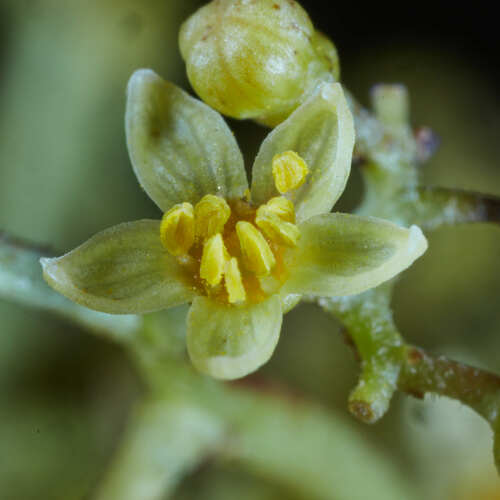
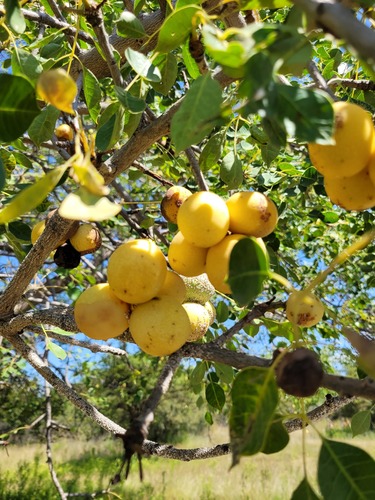
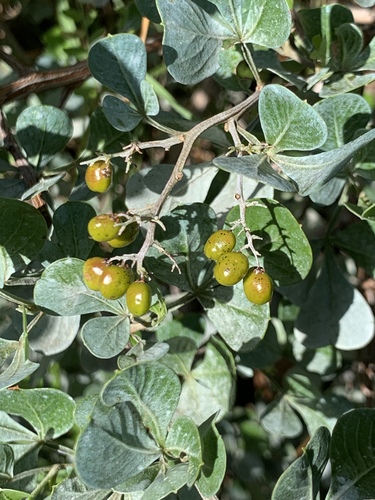
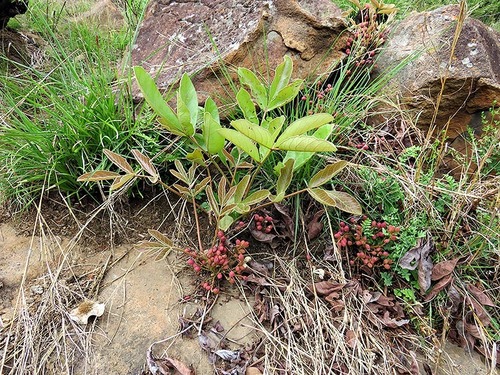
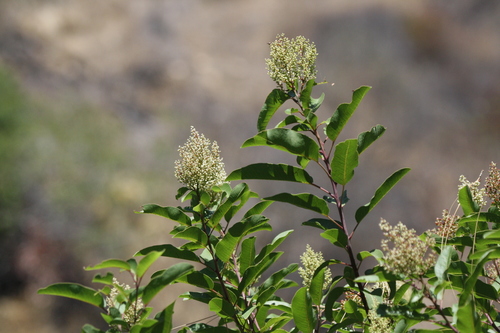
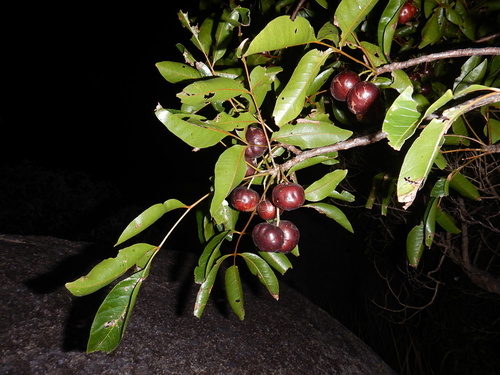
Pleiogynium timoriense is a semi-deciduous rainforest tree. In wild rainforest habitats it reaches up to 20 metres (66 feet) in height, while cultivated individuals typically grow to around 12 metres (39 feet) tall. Older individuals may develop buttress roots. The tree has a dense canopy with glossy dark green leaves; individual leaf blades reach up to 10 cm (3.9 in) long by 6 cm (2.4 in) wide, and the trunk is covered in rough bark. The leaves are imparipinnate, carrying 5 to 11 leaflets arranged in opposite pairs. Leaflets are elliptic to ovate in shape, and the stalk of the terminal leaflet is noticeably longer than the stalks of the lateral leaflets. Prominent domatia occur on the underside of the leaflets. This species is dioecious, meaning individual plants produce only male or only female flowers. Its yellowish-green flowers bloom between January and March. The flower calyx lobes measure around 0.6–1 mm (0.024–0.039 in) long, while the ovate petals are around 1.7–3.8 mm (0.067–0.150 in) long, and the filaments measure 1.3–2.3 mm (0.051–0.091 in) long. The fruit is a depressed-obovoid drupe, growing up to 25 mm by 38 mm (0.98 by 1.50 in). The fruit flesh is most commonly dark plum-coloured purple, though white-fleshed varieties have been recorded, and ripe fruit is edible. The natural distribution of P. timoriense covers Borneo, Sulawesi, the Philippines, the Moluccas, New Guinea, the Solomon Islands, the Cook Islands, Tonga, Fiji, New Caledonia, and Queensland in Australia. It grows in rainforest and monsoon forest from sea level up to 1,000 m (3,300 ft) elevation, and is frequently found along water courses. In Queensland, the species occurs in dry rainforest, littoral and subcoastal riverine rainforest north of the area around Gympie. In its native ecosystem, the fruit of this tree is eaten by cassowaries and great bowerbirds. The fruit is edible, though it has a tart flavour; pale greenish varieties are reported to be more palatable. Indigenous Australians have a documented practice of burying the fruit underground to ripen it. The fruit can be eaten raw, cooked, or processed into jellies, jams and preserves. During his voyage to Australia with Captain James Cook, Joseph Banks collected specimens of the fruit when the expedition stopped at the Endeavour River, and recorded that the fruits were very hard and unpleasant when picked directly from the tree, but became soft after a few days of storage and tasted similar to ordinary damsons. The timber of P. timoriense is decorative, but it is rarely used because good-sized logs are not commonly available.