About Plegadis ridgwayi (Allen, 1876)
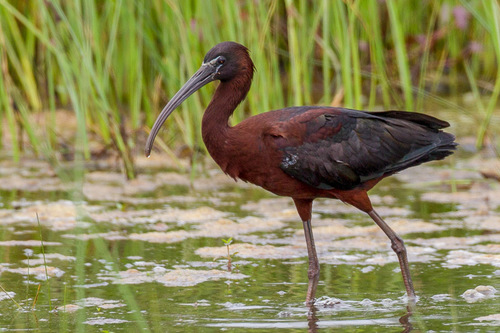
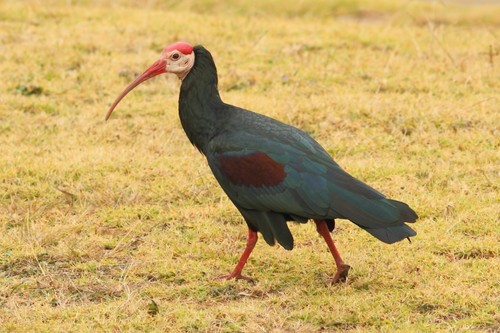
The puna ibis (Plegadis ridgwayi) is a medium-sized waterbird that measures 56–61 cm in height and weighs 478–608 g. It can be identified by its dark purple-brown body, long neck, and red downward-curved bill. Its plumage is iridescent, with a purple or green sheen. There is little sexual dimorphism between males and females, though males are larger than females. Breeding adults can be recognized by their dark chestnut head and neck and red face, while nonbreeding or immature individuals have white streaks on their head and neck and a duller face. This species lives in wetlands across the high Andes, including marshes, lagoons, and shallow lakes. It feeds mainly on invertebrates, and may also eat amphibians and small fish when available. It captures prey by probing through water or mud with its long bill. It breeds in mixed colonies with other waterbirds, and builds nests hidden from predators within tall vegetation. The species is listed as Least Concern on the IUCN Red List. However, exact population numbers are unknown, and the species may face threats such as habitat degradation. Puna ibis are found in Ecuador, Peru, Bolivia, northern Chile, and northeastern Argentina, with the core population residing in Peru and Bolivia. It is a characteristic species of the high Andean region. It occurs from sea level to 5,000 meters in elevation; the greatest concentration in the high Andes is between 3,000 and 4,500 meters, with a significant population between 0 and 500 meters along the coast. It occupies both altitudinal and coastal wetlands including swamps, marshes, lagoons, river banks, and flooded grasslands. It has also been sighted in artificial habitats such as irrigation canals, flooded agricultural lands, and abandoned wastewater treatment plants. Recently, the puna ibis has undergone northward range expansion toward the coast, which may be attributed to habitat degradation in the high Andes. Data on the species' total population size is poor. A past estimate by Hancock et al. put the population in the Lake Junín area of Peru at 8,000, which suggested a total population of around 10,000. This estimate is thought to be lower now due to population decline. Another estimate placed the total population at 10,000–15,000. All these estimates are highly uncertain, and the IUCN Red List lists the total population size as 5,000–20,000. As social birds, puna ibis are colonial nesters, meaning they nest in large groups in the same area. They build their nests in tall vegetation within wetlands, and lay two eggs per clutch. The breeding season aligns with the wet season to provide maximum resource availability for the colony. Both parents incubate the eggs, which take 21–28 days to hatch. Chicks are fairly independent after hatching, but remain under their parents' protection and learn to forage before leaving on their own. Very little is known about the species' courtship behaviour.