About Plegadis falcinellus (Linnaeus, 1766)
Plegadis falcinellus (Linnaeus, 1766), commonly known as the glossy ibis, is a mid-sized ibis species. Adults measure 48–66 cm (19–26 in) in total length, with an average length of around 59.4 cm (23.4 in) and a wingspan of 80–105 cm (31–41 in). Detailed body measurements are as follows: the culmen is 9.7 to 14.4 cm (3.8 to 5.7 in) long, each wing measures 24.8–30.6 cm (9.8–12.0 in), the tail is 9–11.2 cm (3.5–4.4 in), and the tarsus measures 6.8–11.3 cm (2.7–4.4 in). Body weight ranges from 485 to 970 g (1.069 to 2.138 lb).
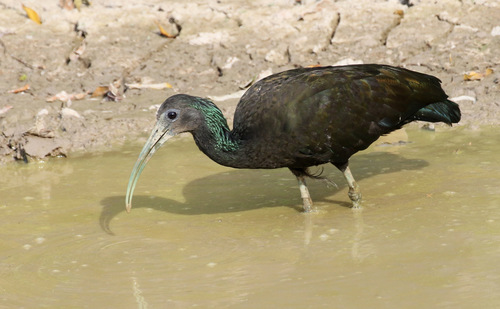
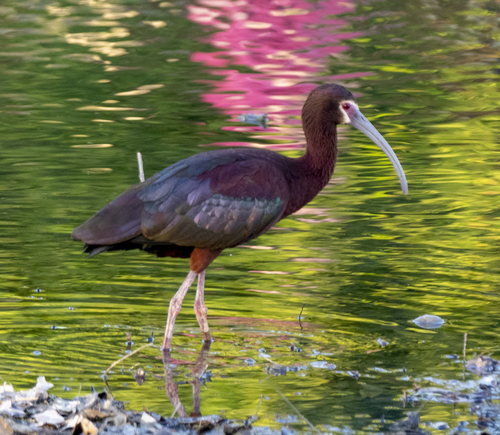
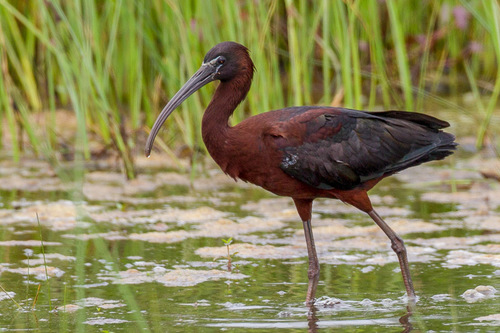
Breeding adults have reddish-brown bodies and distinctly iridescent wing feathers, which range in color from bottle-green to bronzed or purple depending on the angle of light. Breeding adults also have a narrow white facial band running above and below the bill; this band is far less noticeable than the corresponding marking on the closely related, otherwise very similar white-faced ibis. Non-breeding adults and juveniles have duller bodies, with dark brown heads and necks that are finely streaked with white. This species has a brownish bill, dark facial skin that is bordered above and below by blue-grey in non-breeding individuals and cobalt blue in breeding individuals, and red-brown legs. Unlike herons, ibises fly with their necks outstretched; their flight is graceful and often occurs in V formation. The glossy ibis is a rather quiet species, and its calls include a variety of croaks and grunts, including a hoarse grrrr vocalization produced during breeding.
This is the most widespread ibis species, breeding in scattered sites across warm regions of Europe, Asia, Africa, Australia, and the Atlantic and Caribbean regions of the Americas. It is thought to have originated in the Old World, and spread naturally from Africa to northern South America in the 19th century, before expanding further into North America. The glossy ibis was first documented in the New World in 1817 in New Jersey. John James Audubon observed the species just once in Florida in 1832. The species expanded its range substantially northward in the 1940s, and westward in the 1980s.
The glossy ibis is migratory: most European birds winter in Africa, and in North America, birds from areas north of the Carolinas winter farther south. While the glossy ibis is generally considered a migratory species in India, it is resident in western India. Birds from other populations may disperse widely outside of the breeding season.
After experiencing major declines in the 19th and early 20th centuries caused by uncontrolled heavy hunting pressure and habitat loss, the species' population is increasing in Europe. Birds that reached Great Britain and Ireland were routinely shot as trophies until the 1920s, when human attitudes toward the species began to change. It disappeared as a regular breeding bird from Spain in the early 20th century, but re-established breeding there in 1993 after gaining legal protection, and has since increased rapidly, now hosting thousands of breeding pairs across several colonies. It has also established rapidly growing breeding colonies in France, a country that had very few breeding records before the 2000s. However, in Italy, where illegal hunting has remained an ongoing problem despite legal protection for the species since 1977, population growth has been markedly slower, with only 10–50 breeding pairs. An increasing number of non-breeding visitors are seen in northwestern Europe, a region where glossy ibis records were historically very rare. For example, there is a growing trend of birds wintering in Britain and Ireland, with at least 22 sightings recorded in 2010. In 2014, a pair attempted to breed in Lincolnshire, marking the first such attempt recorded in Britain. The first successful breeding in Britain occurred in 2022, when a pair fledged one young in Cambridgeshire. A small number of birds now spend most summers in Ireland, but there is currently no evidence of breeding there. In New Zealand, a small number of birds arrive annually, mostly in the month of July; recently a pair bred within a colony of royal spoonbill. Glossy ibises have been a breeding species in Australia since the 1930s. In India, they are now a breeding species, with colonies found in agricultural areas, forested areas with bamboo thickets, and at breeding sites alongside other colonially nesting waterbirds. Year-round studies have also confirmed that glossy ibises forage in agricultural wetlands and flooded farmlands in western India.
Glossy ibises feed in very shallow water and nest in freshwater or brackish wetlands with tall dense stands of emergent vegetation such as reeds, papyrus (or rushes), and low trees or bushes. They prefer marshes located at the margins of lakes and rivers, but can also be found at lagoons, floodplains, wet meadows, swamps, reservoirs, sewage ponds, paddies, and irrigated farmland. When using farmlands in western India, glossy ibises exhibit strong scale-dependent landscape use that changes with the season: they prefer areas with more than 200 hectares of wetlands during summer, and areas with intermediate amounts of wetland (50-100 hectares) during other seasons, though they do not necessarily forage within the wetlands themselves. The species is less commonly found in coastal locations such as estuaries, deltas, salt marshes, and coastal lagoons. Preferred roosting sites are normally large trees that may be located far from the species' feeding areas. When they do not face human persecution, they will roost in cities, even using trees beside busy highways and other roads.