About Plegadis chihi (Vieillot, 1817)
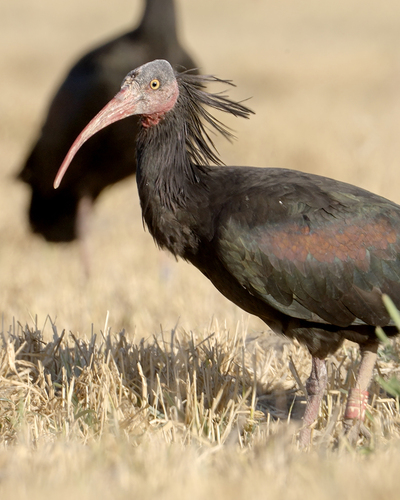
This species, the white-faced ibis, has the scientific name Plegadis chihi (Vieillot, 1817). In non-breeding plumage, it is very similar to the glossy ibis, but tends to be slightly smaller and has somewhat warmer colored plumage. Breeding adult white-faced ibises have a pink, bare face bordered by white feathers, unlike glossy ibises which have a bluish bare face with no bordering feathers. Breeding white-faced ibises also have a grey bill and brighter, redder legs. Adult white-faced ibises have red eyes year-round, while glossy ibises have dark eyes. Juveniles of the two species are nearly identical. The species has the following recorded measurements: length ranges from 18.1 to 22.1 inches (46 to 56 cm), weight ranges from 15.9 to 18.5 ounces (450 to 525 g), and wingspan ranges from 35.4 to 36.6 inches (90 to 93 cm). The white-faced ibis is found in Canada, the United States, and Central America. A second subspecies lives in the southern half of South America, east of the Andes Mountains. No migration or interchange occurs between the North American and South American subspecies. As of 2012, the total global population was estimated at 1.2 million individuals, and the population is increasing. The IUCN lists the white-faced ibis as a species of Least Concern. Within North America, white-faced ibises that breed in northern parts of the range migrate south to wintering areas. For example, individuals that breed in northern California and southern Oregon move to wintering areas in southern California, Mexico, or Central America. Some individuals that breed in Yellowstone, Wyoming will overwinter in areas such as Texas and coastal Gulf of Mexico regions.