About Plecturocebus moloch (Hoffmannsegg, 1807)
This species, commonly known as the red-bellied titi, has the scientific name Plecturocebus moloch (Hoffmannsegg, 1807).
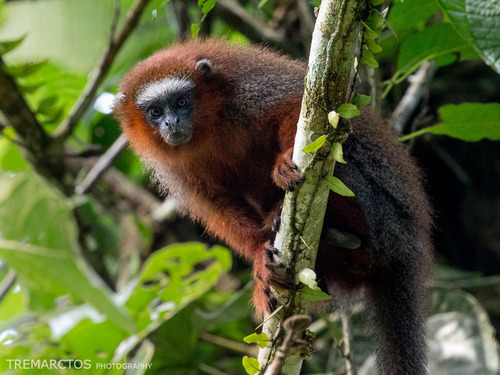
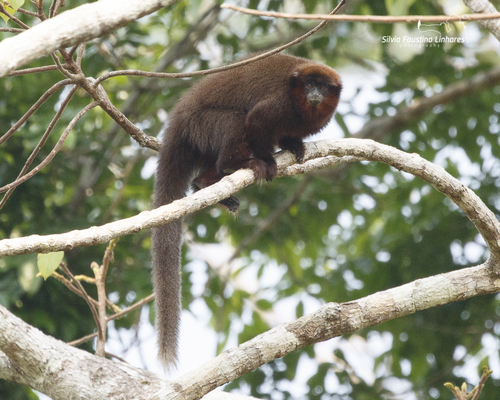
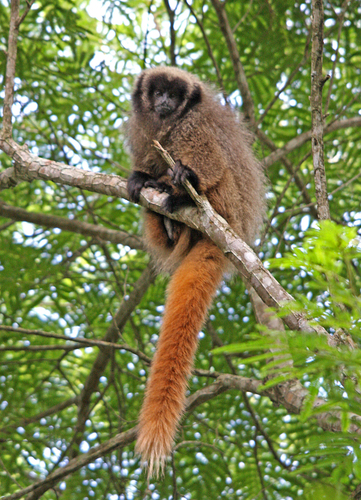
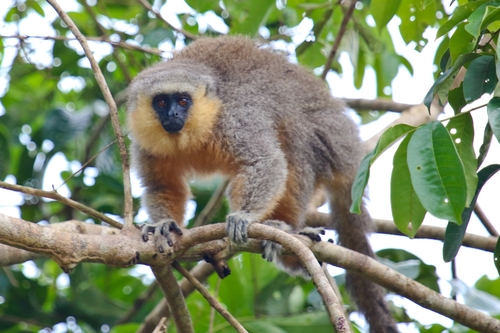
Physical description: Male red-bellied titis have an average head and body length of 333 mm (13.1 in), while females have an average head and body length of 331 mm (13.0 in), so the species shows no sexual dimorphism in head and body length. Its tail is longer than the combined length of its head and body. Males weigh between 850–1,200 g (1.87–2.65 lb), and females weigh between 700–1,020 g (1.54–2.25 lb). Its pollex (thumb) is larger than its hallux (big toe). It has six palmar pads, and each of its five digits ends in a nail. Its dental formula is i 2/2, p 3/3, m 3/3, giving it a total of 36 teeth. Its upper incisors are elongated, and its incisiform canines barely extend past the other teeth. Upper molars are sometimes tricuspid; lower premolars are relatively simple, and both upper and lower molars are quadricuspid. It has relatively large ears that are often hidden by the fur on the side of the head. Its nose has a wide internal septum, and the nares open laterally. In adult individuals, the back pelage can be grey, reddish, or brown. It usually has white or black bands on its forehead, and this color pattern is present in both young and adult individuals. On the ear, the helical margin is pulled upward and toward the back, and the anterior superior margins are rolled. The tragus and antitragus are small, lobulated, and equal in size. The manus has unique raised pads; the interdigital pads are separated from the palm by a structure called the deep flexor line. The palm is made up of two elongated central pads, a hypothenar pad, and a thenar pad. Its skull is orthognathous, its orbits are unfenestrated, the bullae are inflated ventrally, and a large sinus is found above the nasal cavity. The foramen magnum is located toward the front, and the atlas has shallow anterior articular facets that allow the condyles to attach. The anterior margin of the lacrimal fossa is formed by or near the maxilla. The premaxilla is short, which gives the face a small, less prognathic appearance compared to other platyrrhines. The corpus of the mandible deepens toward the posterior end, and the ramus is tall. The hyoid bone is expanded and highly convex ventrally.
Behavior and ecology: Red-bellied titi social groups range in size from two to four individuals, and usually consist of one adult female and one adult male. Young red-bellied titis typically leave their natal group when they are 2–3 years old. This species rarely interacts with other primates. The bond between adult male-female pairs is extremely strong. Once a pair bond is established, partners stay very close to one another, and pairs will intertwine their tails whenever possible. Pairs also tend to follow one another and stay close throughout the day. Males play a major role in caring for young; siblings do not play any role and do not usually help rear young. Adults use chest rubbing as a visual signal, dragging branches slowly along their chest. After dragging the branch, the chest area is smelled or rubbed. Red-bellied titis inhabit lower, dense tropical forest, especially areas close to rivers and river banks. They have a frugivorous diet, and eat fruits, twigs, leaves, and insects. They have a relatively small home range. Like other titis, they are highly territorial and use vocal calls to mark territory and scare off other animals. Grooming occurs frequently throughout the day, mostly during rest periods. All members of a social group—both females and males, adults and young—participate in grooming. It has been suggested that grooming acts as a form of habituation that introduces individuals to the presence and physical contact of companions. Adults and juveniles will also intertwine tails with opposite-sex members of the same social group when they are near each other.
Red-bellied titis use a variety of postures and facial expressions as visual signals. Examples of these signals include swaying the entire body, turning the head sideways, and lowering the head to face downward. These signals have been observed as a response to disturbance or when the individual has a tendency to escape. Back arching is a signal that warns of an impending attack, and is associated with hostility; an attack usually follows after a red-bellied titi arches its back. Other hostile signals include piloerection and tail lashing, which tend to follow back arching and are often used as scare tactics. Observed facial expressions in this species include partial and complete closing of the eyes, protrusion of the lips, and baring of the teeth, which is usually followed by lip smacking. Infants are mostly transferred and tended to by males; females only lick and nurse infants. Adult males are responsible for carrying infants, except when the infant is being nursed or licked. Juveniles will sometimes move themselves between adults, especially when the two adults are close to each other. There is a close association between males and juveniles after the juvenile becomes capable of self-locomotion.