About Plecturocebus donacophilus (d'Orbigny, 1836)
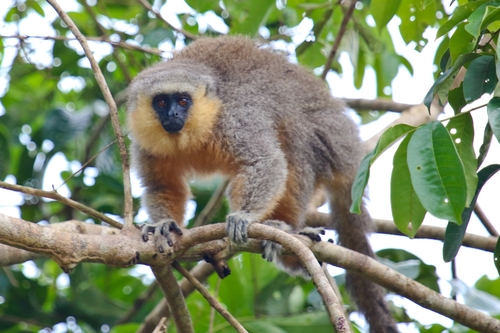
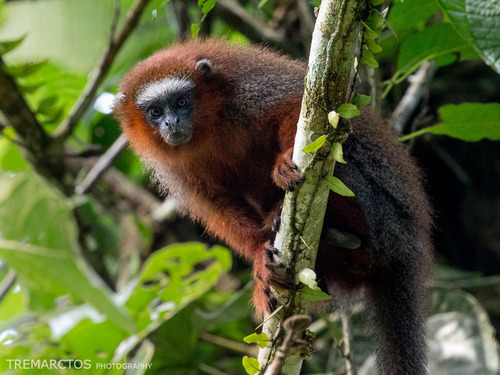
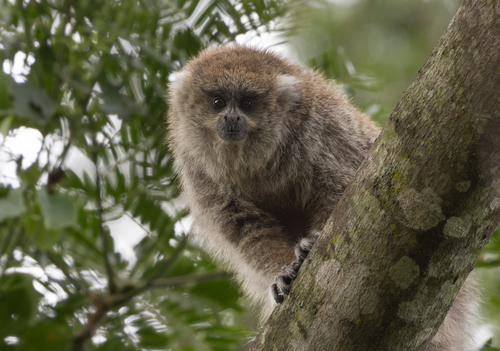
Plecturocebus donacophilus, commonly called the white-eared titi, is a medium-sized primate. This species has no sexual dimorphism: average male head-and-body length is 311 millimetres (12.2 in), while average female head-and-body length is 340 millimetres (13 in). Females are generally slightly lighter in body weight, which ranges from 800 to 1,200 grams (1.8 to 2.6 lb) overall. The white-eared titi has grey to orange pelage, with thick fur. Its dorsal side and limbs range in color from grey agouti to orange agouti, it has an orange underside, and distinct white ear tufts. Its fluffy tail is longer than the combined length of its head and body. It has a dental formula of 2.1.3.3/2.1.3.3 × 2 = 36: on each side of each jaw, it has two incisors, one canine tooth, three premolars, and three molar teeth. Compared to other New World monkeys, its canine teeth are relatively short. Captive white-eared titis have been recorded living over 25 years. The white-eared titi inhabits tropical humid forests, and actually prefers drier regions over more humid ones. It occurs in riparian zones and gallery forests, and is strongly associated with open habitats such as grasslands and swampy grasslands. It prefers areas with dense vegetation, and often lives in the thickest parts of the forest. The species shows notable tolerance to habitat disturbance. Its distribution covers parts of Bolivia and Brazil: in Bolivia, it lives in the upper basins of the Mamoré, Grande, and San Miguel rivers, east of the Manique River in Beni, and in the forests surrounding Santa Cruz de la Sierra; its range extends north into southern Rondônia, Brazil. Relatively little is known about the ecology of the white-eared titi, or even titi monkeys as a whole, with few studies focused specifically on this species. It is diurnal: it becomes active around sunrise and remains active until sunset. Food availability can alter its activity times: when food is abundant during warmer fruiting months, it may start activity earlier, while when food is scarce, it may stay at its feeding tree into the evening. It typically rests during the middle of the day, has two main feeding periods in the morning and afternoon, and has an extended feeding period towards the end of the day. On average, it is active for 11.5 hours total each day, 2.7 hours of which are spent feeding. It sleeps on branches at least 15 metres (49 ft) above the ground. Like when resting during the day, sleeping white-eared titis huddle together and twine their tails. While there is little published research specifically on the white-eared titi's diet, titi monkeys overall are omnivores that eat fruit, leaves, insects, and seeds. They feed mostly on leaves, particularly young leaves and leaf buds that are high in protein, so they spend a large portion of the day resting to digest the cellulose in these leaves. In total, they consume food from over 100 different plant species. They also eat small insects including ants, moths, butterflies and their cocoons, as well as spiders, and can catch flying prey that comes near their position. Feeding time spent on leaves increases during the dry season, and it is thought that insect consumption increases during lactation to boost the protein content of the diet. The white-eared titi travels between 425 and 1,152 m (1,394 and 3,780 ft) each day, and maintains a home range of 0.005 to 0.14 km² (0.0019 to 0.0541 sq mi). During the dry season, less fruit is available, so the species does not need to travel as far; its daily travel distance in the dry season is often only one third of its usual distance. The white-eared titi often shares its home range with other primate species, including marmosets, squirrel monkeys, capuchins, owl monkeys, howler monkeys, and spider monkeys. Larger primate species will sometimes chase it away from feeding sites, and the white-eared titi generally tries to avoid other primates.