About Plectropomus pessuliferus (Fowler, 1904)
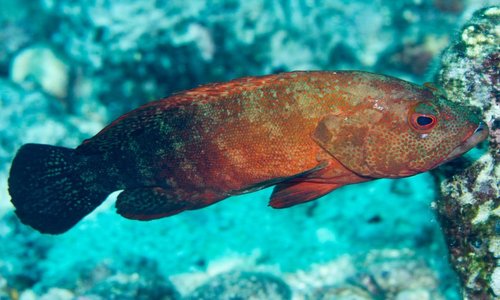
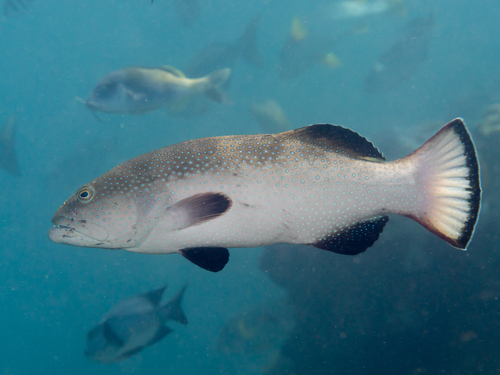
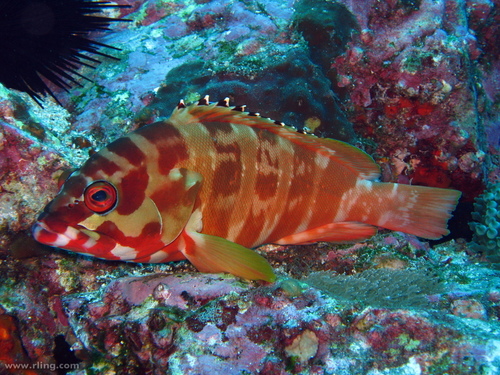
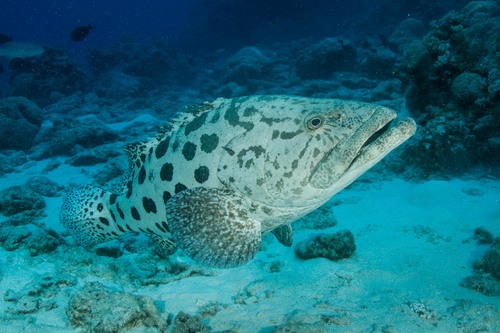
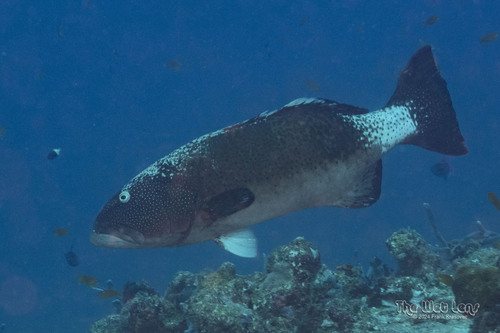
The roving coral grouper, Plectropomus pessuliferus, has an elongated, robust body, with a standard length 2.9 to 3.9 times its body depth. Its preopercle is mostly rounded, with three large, downward-pointing spines along its bottom half. The gill cover has two skin-covered spines on either side of a hairless central spine. The dorsal fin holds 7 to 8 spines and 10 to 12 soft rays, while the anal fin has 3 spines and 8 soft rays. The spiny section of the dorsal fin has a shorter base than the soft-rayed section. The caudal fin is truncate in adult fish and emarginate in juveniles. The head, body, and fins range in color from brown to orange-red, marked by many small blue spots that each have dark edges. Some of these spots on the head and flanks are elongated, usually vertically, and the lower body has far less spotting. There is often a blue ring around the eye, though this ring may be broken. This species reaches a maximum total length of 120 centimeters, or 47 inches. The roving coral grouper is a widespread but fairly rare species found across the Indo-Pacific. Its range extends from the Red Sea, south along the East African coast to Mozambique and Madagascar, and east across the Indian Ocean to the Coral Triangle in the Western Pacific Ocean. Roving coral groupers inhabit coral reefs, specifically shallow lagoons and seaward reefs, at depths between 25 and 147 meters. This carnivorous species feeds mainly on fishes and crustaceans. It sometimes takes part in cooperative hunting with the giant moray Gymnothorax javanicus, the humphead wrasse Cheilinus undulatus, or the big blue octopus Octopus cyanea.