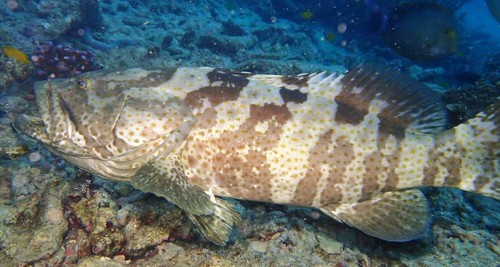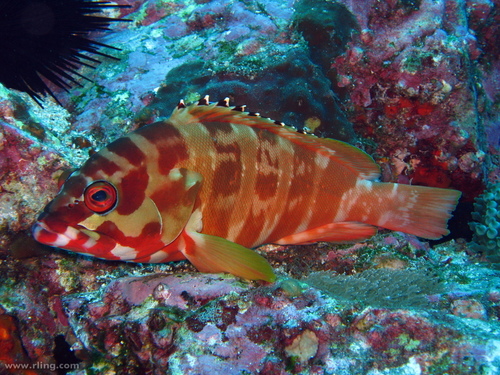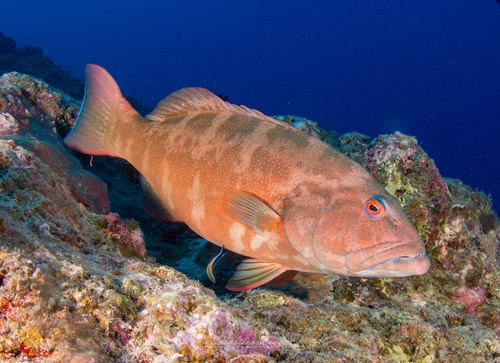
About Plectropomus leopardus (Lacepède, 1802)
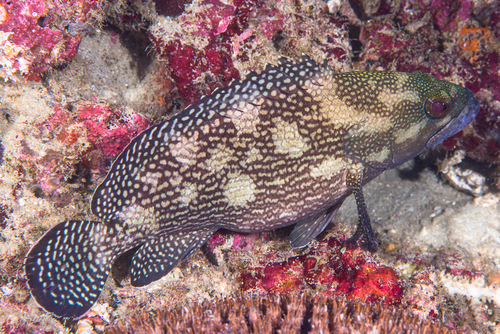
Plectropomus leopardus, commonly called the leopard coral grouper, has an elongated, robust body, with a standard length 2.9 to 3.9 times the body depth. Its preopercle is mostly rounded, with three large, downward-pointing spines along its lower half. The dorsal fin holds 7–8 spines and 10–12 soft rays, while the anal fin holds 3 spines and 8 soft rays; the spiny portion of the dorsal fin has a shorter base than the soft-rayed portion. The caudal fin is emarginate. Its body background color ranges from olive green to reddish brown or orange-red. The upper part of its body is covered in regularly spaced bright blue spots, and it has a blue ring around the eye, which may be broken. This species can change color quickly, and frequently develops a mottled pattern while hunting. It reaches a maximum total length of 120 centimetres (47 in), though most commonly grown individuals are around 35 centimetres (14 in). The maximum published weight is 23.6 kilograms (52 lb), but this is thought to be incorrect (and likely attributed to P. leavis instead), as the Australian spearfishing record for P. leopardus is 10.250 kilograms (22.60 lb). This species is found in the western Pacific Ocean, distributed from southern Japan to Australia, and east from the east coast of Thailand and Malaysia to the Solomon Islands, Caroline Islands and Fiji. In Australia, it occurs at Beacon Island in Western Australia, the Ashmore and Cartier Islands in the Timor Sea, along the tropical northern coast as far south as Sydney. This range includes reefs in the Coral Sea, Christmas Island, the Cocos (Keeling) Islands, and waters around Lord Howe Island in the Tasman Sea. The leopard coral grouper lives on coral reefs at depths between 3 and 100 metres (9.8 to 328.1 ft). The "Effects of Line Fishing" (ELF) project studied P. leopardus populations to assess size and age structures during reproduction, and understand how fish stocks respond to different levels of fishing pressure. This species is a protogynous hermaphrodite: all individuals start life as females, and change sex later in life. The trigger for this sex change is not known. On average, sex change occurs when fish are between 23 and 62 cm (9.1 and 24.4 in) in length, with an average length at sex change of 42 cm (17 in). Sex change is believed to happen most often in the months immediately after spawning. ELF research found that the sex ratio differs across different areas of the Great Barrier Reef, and may differ between fished and protected reefs. Sex ratios are an important management consideration, because changes to the ratio could seriously affect reproduction and the number of new juveniles entering the fishery in future years. Both males and females can be found in all length classes, though small fish are almost always female, and most large fish are male. Spawning occurs when water temperatures rise to between 25.0 and 26.5 °C (77.0 to 79.7 °F) during late spring. On the northern Great Barrier Reef, spawning takes place between September and December, while in cooler southern regions, spawning occurs between October and February. The start and end of spawning can vary year to year, corresponding to variation in water temperature. Leopard coral groupers typically form dense aggregations to spawn. These aggregations form around reef slopes at depths of 10 to 15 m (33 to 49 ft), and spawning activity peaks at the new moon. Spawning happens during periods of strong tidal flow, particularly ebb tides. This is thought to carry newly released eggs far from the reef, away from reef-associated predators. Spawning typically takes place at dusk, when low light levels make it hard for predators to see and feed on the eggs. When spawning aggregations form, males establish temporary territories. They then attempt to entice females into their territories to spawn through elaborate courtship displays. As part of this ritual, males display the darkened edges of their fins, which they can activate and deactivate almost instantly. The male approaches a female, who is usually close to the seabed, with his body tilted at an angle of 45–90° (almost lying on his side in the water). He repeatedly quills along the length of his body and shakes his head from side to side, and passes close to the female's head or body with either the top or underside of his body. This process repeats. If the female accepts the male after courtship, a spawning rush occurs. During a spawning rush, the male and female swim rapidly toward the surface, and release sperm and eggs into the water as they turn quickly. The cloud of sperm and eggs released during a spawning rush is not easy to spot, but its presence can sometimes be detected by the frantic feeding of small zooplankton-eating fish. Spawning typically takes place over a 30 to 40 minute period at sunset, and some individuals, especially males, may spawn more than once in a single evening. Like most reef fish, leopard coral groupers have a larval stage where eggs and larvae develop in the water column, which allows larvae to disperse to nearby reefs. Fertilization occurs after spawning, and fertilized eggs float just below the water surface. The incubation period for P. leopardus eggs is not confirmed, but it is thought to fall between 20 and 45 hours, matching the incubation period of closely related species. Newly hatched larvae are underdeveloped and gain nutrients from a yolk sac. As they develop, their spines, fins, gut, other internal organs, and senses all fully form. Once the yolk sac is fully absorbed, the larvae can see and begin catching their own prey. The fastest period of growth for leopard coral groupers happens in the first three years of life. The average daily growth of newly settled juveniles has been measured at 0.81 mm per day, meaning they reach almost 14 cm (5.5 in) in their first 6 months. Growth rates in this species are variable, and every age class has a wide range of individual sizes. To estimate growth, researchers must measure the age and size of each fish studied. Most often, growth is measured by collecting individuals of different sizes, measuring their length, and determining their age from their otoliths. Recent research at Bramble Reef found that P. leopardus reaches a maximum age of 16 years.