About Plectropomus laevis (Lacepède, 1801)
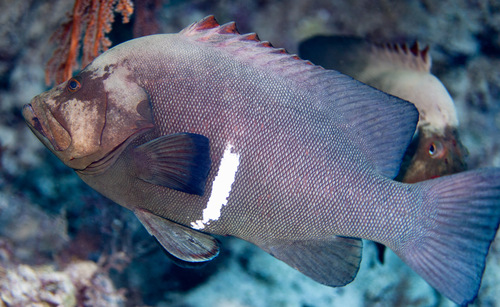
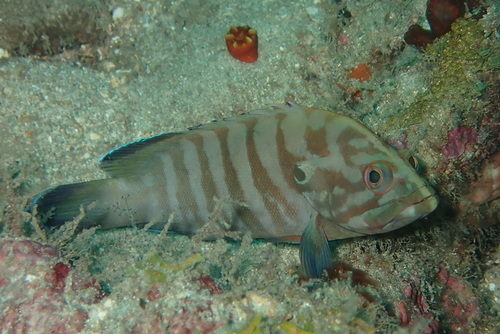
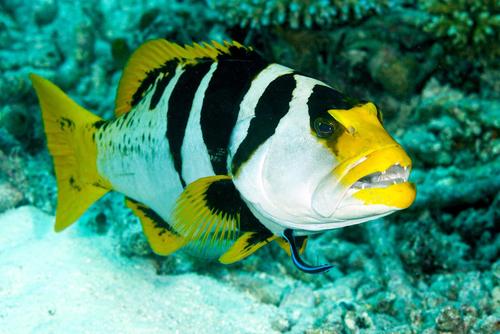
Plectropomus laevis has an elongated, robust body, where the standard length is between 2.9 and 3.9 times the body depth. Its preopercle is mostly rounded, with three large, downward-pointing spines along the bottom half. The dorsal fin holds 7–8 spines and 10–12 soft rays, while the anal fin has 3 spines and 8 soft rays. The spiny portion of the dorsal fin has a shorter base than the soft-rayed portion, and the caudal fin is truncate. This species has two distinct colour phases: one, called the "footballer phase", has black saddles on a whitish background, with a yellow caudal peduncle and yellow fins; the other is a greyish form with a dark head, five dark saddle markings along the back, and small blue spots on the body. Juveniles of Plectropomus laevis are Batesian mimics of the toxic Valentin's sharpnose puffer (Canthigaster valentini). This species reaches a maximum total length of 125 centimetres (49 in), with common individuals measuring around 84 centimetres (33 in), and the maximum published weight is 24.2 kilograms (53 lb). Plectropomus laevis has a wide distribution across the Indo-Pacific. It occurs from Kenya to Mozambique in eastern Africa, through the tropical Indian Ocean islands (but not the Asian coast), and extends east into the Pacific Ocean as far as French Polynesia and Pitcairn Island, north to southern Japan, and south to Australia. In Australia, it is found at Rowley Shoals and Scott Reef in Western Australia, Ashmore Reef in the Timor Sea, the Great Barrier Reef extending south to One Tree Island, other reefs in Queensland's Coral Sea, and the region around Lord Howe Island in the Tasman Sea. Plectropomus laevis inhabits coral-rich lagoon areas and the seaward side of reefs, and it prefers reef channels and the outer shelf of the reef. It occurs at depths ranging from 4 to 100 metres (13 to 328 ft). Juveniles of both colour phases that are less than 20 centimetres (7.9 in) in total length mimic Valentin's sharpnose puffer. They typically swim by sculling with their pectoral fins, while holding the caudal fin folded and the first few spines of the spiny dorsal fin erect. This species forages over larger areas and across a wider depth range than the sympatric Plectropomus leopardus. Plectropomus laevis is a monandric protogynous hermaphrodite, meaning males only develop from mature females. The youngest recorded males were 9 years old, while females reach maturity at 2.2 years of age and around 40 centimetres (16 in) in fork length. This species grows comparatively quickly; it can reach 50 centimetres (20 in) in length in less than four years, and females can become sexually mature in less than three years. It forms small spawning aggregations, though large aggregations have been recorded on the northern Great Barrier Reef. It is likely that this species spawns in deeper water on reef fronts compared to P. leopardus, which may explain the lack of documented spawning observations for P. laevis. Adult individuals feed on a variety of larger reef fishes, including other groupers, while juveniles feed on smaller fish and invertebrates such as crustaceans and squid.