About Plectropomus areolatus (Rüppell, 1830)
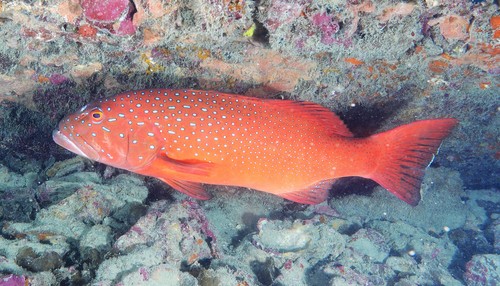
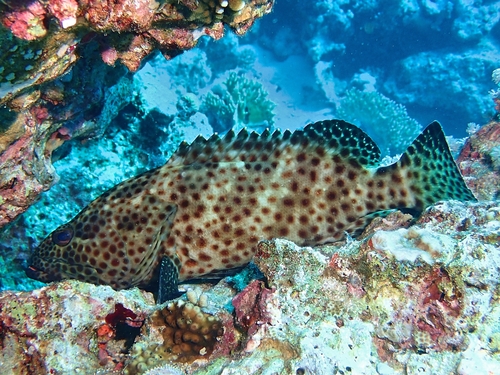
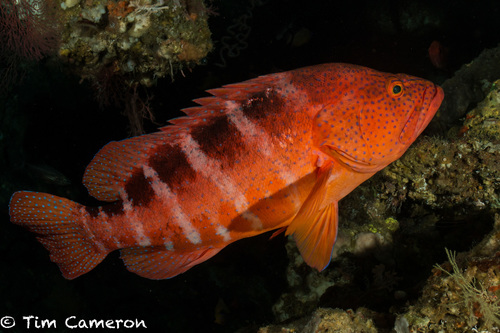
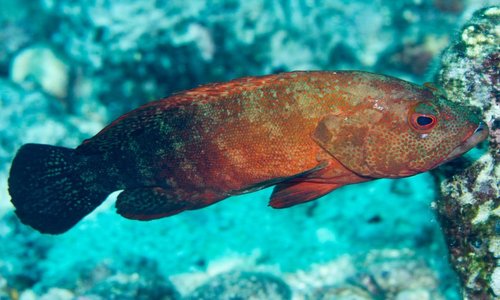
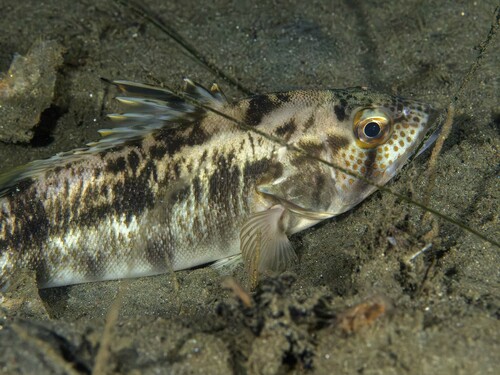
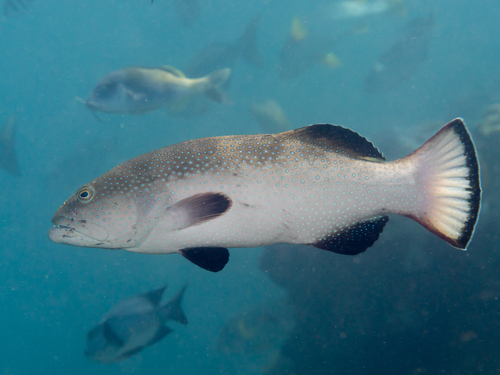
The squaretail coral grouper, Plectropomus areolatus (Rüppell, 1830), has an elongated body. Individuals reaching first maturity measure approximately 36.65 cm in length and weigh around 771.2 grams, and the species can reach a maximum total length of 80 cm, with females typically growing longer than males. This species has 7 to 8 dorsal spines and 10 to 12 soft dorsal rays, while its anal fin has 3 spines and 8 soft rays. It has between 1 and 4 canines on the upper jaw. Its caudal fin, or tail, is truncated, ending in a straight vertical edge – this feature gives the species its common name. Squaretail coral groupers display a wide range of possible coloration, from whitish gray with dark spots, to greenish-gray, to a red and brown patterned body. All of its fins are dark brown. This grouper is found across the western Pacific Ocean, including waters surrounding Japan, southeastern China, the Philippines, Indonesia, and Australia. It also occurs in the Indian Ocean near East Africa. It inhabits shallow, coral-rich lagoonal and seaward reef areas, particularly channels along the reef front. It is commonly found widely across coral reefs or rocky reefs in tropical and subtropical waters, and typically occurs at depths between 1 and 70 meters in the marine neritic zone, the nearshore marine environment extending to 200 meters along the continental shelf. Squaretail coral groupers have small home ranges, and most individuals stay close to their aggregation site, with dispersing larvae spreading out within a 14.4 kilometer radius. Their aggregation sites are located relatively close to one another. Of 32 studied grouper aggregations, 59% of squaretail coral groupers formed aggregations at sites shared with other grouper species, while 41% formed single-species aggregations. The species often co-aggregates with camouflage groupers and brown-marbled groupers, but it also maintains aggregation sites that are only used by its own species. At some of these single-species sites, squaretail coral groupers aggregate on low-relief reef habitats that do not appear able to support aggregations of the other co-occurring species. The peak spawning season for the squaretail coral grouper runs from January to April, lasting for 2 to 3 months total. Spawning events occur during new and full moons, which may suggest a connection to associated high tidal variation and flow to improve larval dispersal or retention. However, similar to water temperature, consistent lunar periodicity is not a reliable indicator of spawning timing, and the species shows reproductive variability relative to lunar cycles. While some regional similarities exist, water temperature profiles also cannot be used reliably to predict spawning, because the water temperatures recorded during reproductive periods vary between locations. Spawning aggregations form monthly year-round. The purpose of these aggregations is spawning, indicated by observed color changes, fighting, quivering, and the presence of multiple gravid females. When aggregating to spawn, males usually arrive either individually or in small groups to establish territories, and they arrive earlier than females. Females generally arrive in large schools. Squaretail coral groupers reach sexual maturity at around 2.8 years of age and have an average lifespan of approximately 10 years. After hatching from an egg, the species begins life as a planktonic larva before maturing into an adult fish. There has been some proposed evidence of protogynous hermaphroditism, or sex change from female to male, in this species. Evidence for this theory comes from gonad tissue that may contain both male and female sexual organs, testes and ovaries. One early study found that 18 out of 448 sampled individuals were transitioning from female to male. A later follow-up found potential errors in the original study, leaving the theory of protogynous hermaphroditism in this species unresolved.