About Plectorhyncha lanceolata Gould, 1838
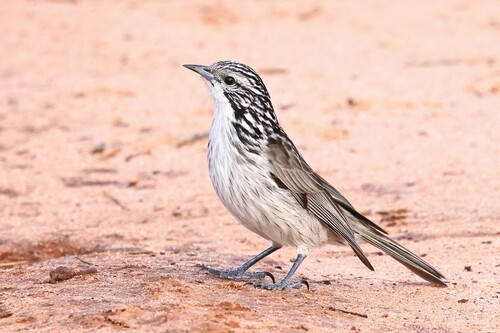
The striped honeyeater (Plectorhyncha lanceolata Gould, 1838) is a medium-sized honeyeater. Adult individuals have a body length of 22–25 cm (8.7–9.8 in), a wingspan of 28–36 cm (11–14 in), and an average weight of 40 g (1.4 oz). The upperparts of this species are generally light greyish brown, with dark brown centres to each feather that create an overall striped appearance. These stripes are prominent on the head and nape, less distinct on the rump, and almost completely absent from the upper tail coverts. The underparts are whitish, with faint streaks visible on the belly. Feathers on the upper breast and throat are long and pointed, which gives the head a distinctly spiky look. Both the wing and tail are moderately long with rounded tips. The bill is short and sharply pointed, with dark blue-grey colour that grades to grey-black at the tip and around the nostrils. Legs and feet are blue-grey, with black claws. The bare skin surrounding the eye is dark brown, and the iris is dark black-brown. Male and female striped honeyeaters look identical to one another. Juvenile birds are slightly browner than adults, with buff or brown edges along the feathers of the wings and back. They also have a duller, less heavily streaked appearance than adult birds. Juveniles moult into full adult plumage at approximately one year old. There is no seasonal difference in the plumage of breeding striped honeyeaters. The species' song is described as chirp, chirp, cherry, cherry; its contact call is a sharp chewee, and its alarm call is a shrill, whistling note. The striped honeyeater occurs mainly in eastern Australia, predominantly in inland areas. It originally inhabited drier open forests such as mallee and mulga, but can also be found in coastal heathland and mangroves. In 1923, an observer was surprised to document a small group of striped honeyeaters nesting at Forster on the New South Wales mid-north coast, noting it was remarkable for this normally inland species to reach the coast. Since that observation, the species' range has expanded. Contemporary records place its distribution as eastern Australia, from central and southeast Queensland extending inland to southeast South Australia, and along the coast south to the Tuggerah Lakes, New South Wales. Small irruptions linked to weather patterns and habitat changes have been recorded in areas outside the species' usual range, including the Grampians and the Adelaide Plains. It can be found in a wide variety of habitats: riparian woodlands (such as river red gum, bimble box and black box) with an understory of lignum or saltbush; mallee woodland, especially when mixed with thickets of broombush or emu bush; native pine woodlands growing on sand ridges; and semi-arid scrubland dominated by Acacia including lancewood. On the coast, the striped honeyeater lives in swamp forests of paperbark and Casuarina, and also occupies developed areas that contain native and exotic trees and shrubs. These developed areas include caravan parks, reserves, gardens, farms, and orchards.