About Plectorhinchus polytaenia (Bleeker, 1853)
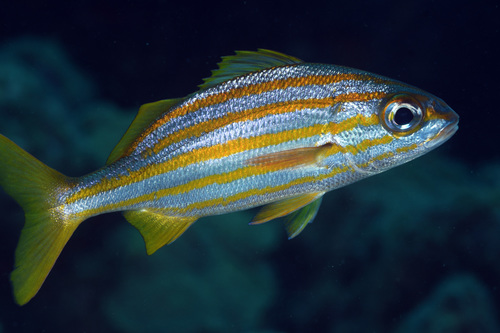
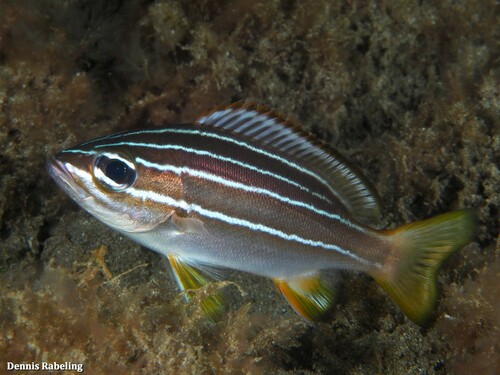
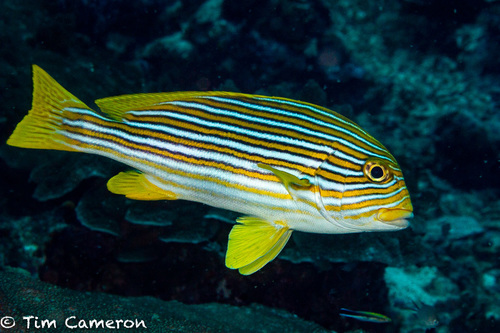
The ribboned sweetlips (Plectorhinchus polytaenia) has fleshy lips that become moderately swollen as the fish ages. There are 6 pores on its chin, but no median pit. The dorsal fin has 12 to 13 spines and 19 to 22 soft rays, while the anal fin has 3 spines and 7 to 8 soft rays. Its body background colour ranges from brown to yellowish grey, and is marked by 5 to 9 fairly thin grey or white horizontal stripes with dark brown edges; these stripes extend around the snout. The fins are yellow, with darker stripes on the soft-rayed part of the dorsal fin, the caudal fin, and the pectoral fin. These darker stripes fade with age, and are completely absent in the oldest fish. The eyes and lips are yellowish, the inside of the mouth is bright red, and the chin is white. Juveniles have fewer stripes on their orange-brown bodies, with a central black band being the most obvious marking. This species reaches a maximum total length of 50 cm (20 in). Ribboned sweetlips occur in the Indo-Pacific region. Their range extends from the west coast of India to the Malay Archipelago, the Philippines, and New Guinea, and stretches east as far as the Solomon Islands and south to north-western Australia. This species lives at depths between 5 and 40 m (16 and 131 ft) on coastal and seaward reefs. Adult ribboned sweetlips prefer deep slopes exposed to currents that support rich growths of benthic invertebrates. Juveniles are typically found on more sheltered reefs near the adults' habitat. They are normally solitary, but may gather in small or large groups to rest during the day. These groups disperse over the reef at night to forage for small prey including crustaceans, gastropods, annelids, and smaller fishes. It is an oviparous species that spawns as distinct pairs.