About Plectorhinchus picus (Cuvier, 1828)
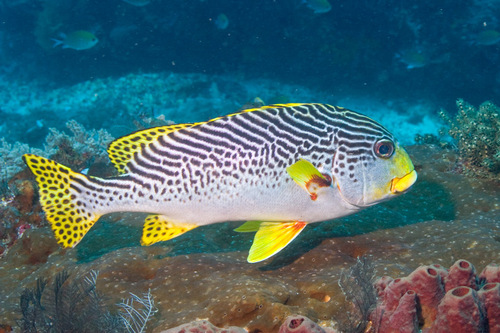
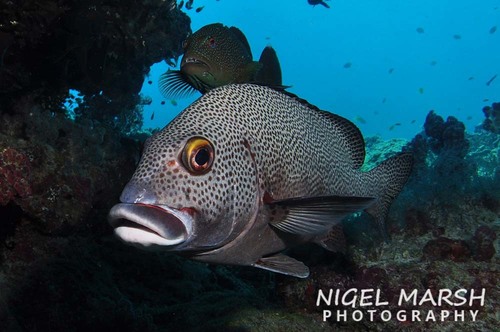
Plectorhinchus pica has fleshy lips that swell as the fish ages. It has 6 pores on its chin, with no median pit. Its dorsal fin is made up of 12 to 14 spines and 17 to 20 soft rays, while its anal fin has 3 spines and 7 to 8 soft rays. Adult Plectorhinchus pica have a pattern of dark brown spots that cover the head, back, flanks, and fins. Their dorsal fin is dark brown to blackish, with large black spots and a central longitudinal grey stripe that runs along the fin membranes, not the spines or rays. In some individuals, there is a patch of bright red at the base of the pectoral and pelvic fins. The inside of the mouth, the rear margin of the maxilla, and the gill membranes are scarlet to reddish-brown. The abdomen, part of the underparts, is pale greyish purple. Juvenile Plectorhinchus pica are white on the lower body and black on the upper body; the black area is broken by a white snout, plus white saddle marks and spots. This species reaches a maximum total length of 84 cm (33 in), though a length of 70 cm (28 in) is more typical.
Plectorhinchus pica is native to the Indo-Pacific region. Its range extends from Socotra, the Seychelles, the Comoros Islands, Madagascar, and Mauritius eastwards into the Pacific Ocean as far as the Society Islands. In the Pacific, it ranges north to southern Japan and the Ogasawara Islands, and south to Australia, New Caledonia, and Rapa Iti. In Australian waters, it occurs along the Great Barrier Reef, stretching as far south as Jervis Bay in New South Wales. Juveniles have been recorded as far south as Barunguba / Montague Island, and the species is also found at Lord Howe Island in the Tasman Sea.
Plectorhinchus pica inhabits both lagoons and seaward reefs. Adults usually hide within caves or underneath coral heads, most often along reef margins. Juveniles are commonly found in shallow lagoons. Adults are solitary, and they feed on crustaceans, molluscs, and smaller fish. This is an oviparous species that spawns as distinct pairs. They stay hidden in shelters during the day and forage at night.