About Plectorhinchus lineatus (Linnaeus, 1758)
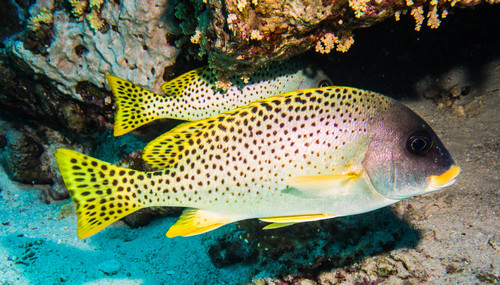
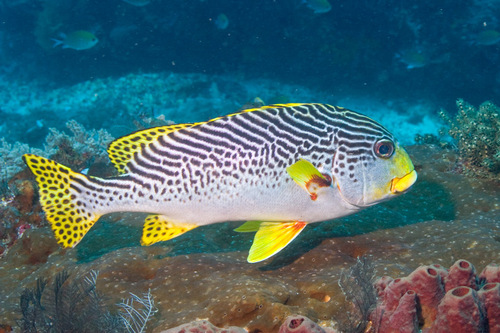
Plectorhinchus lineatus (Linnaeus, 1758) has fleshy lips that become moderately swollen as the fish ages. It has 6 pores on its chin and lacks a median pit. Its dorsal fin has 12 to 13 spines and 18 to 19 soft rays, while its anal fin has 3 spines and 7 to 8 soft rays. Adult fish have an overall light grey body that fades to white on the belly, with prominent yellow lips. The upper body is marked by numerous broken diagonal black stripes. All fins are yellow; the caudal, anal, and dorsal fins bear black spots, and the pelvic fins have red spots at their bases. Juveniles start with a small number of horizontal to slightly angled dark brown bands. As the fish grows, these bands break up, leaving the upper body dark chocolate brown broken by a web of thin white lines across the back. With further growth, the wide brown bands on the lower flanks break up into spots, which continue to shrink as the fish matures. This species reaches a maximum total length of 72 cm (28 inches).
Plectorhinchus lineatus is distributed in the eastern Indian Ocean and western Pacific Ocean. Its range extends from Indonesia east to the Philippines and New Ireland, north to the Ryukyu Islands and Ogasawara Islands, and south to New Caledonia and Australia. In Australia, it occurs at Scott Reef in Western Australia, Ashmore Reef in the Timor Sea, and along the Great Barrier Reef as far south as the Capricorn Islands and Gold Coast Seaway in Queensland.
This species lives in deep waters at depths between 1 and 35 meters (3 feet 3 inches to 114 feet 10 inches), inhabiting both inner and outer reefs. Adults can be found either alone or in groups along coral slopes in clear water. Juveniles are solitary and live on shallow, sheltered reefs. It is typically a nocturnal species: it forages for benthic invertebrates in open sand areas and seagrass beds during the night, and rests during the day. This oviparous species forms spawning pairs, and spawning aggregations have been recorded off Palau around the new moon. During the day, it can often be found resting near coral brommies, which are columnar coral outcrops that are often exposed at low tide.