About Plectorhinchus gibbosus (Lacepède, 1802)
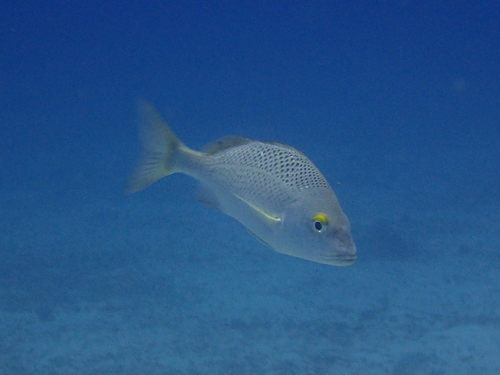
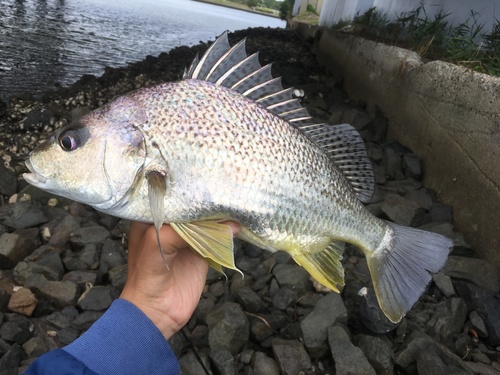
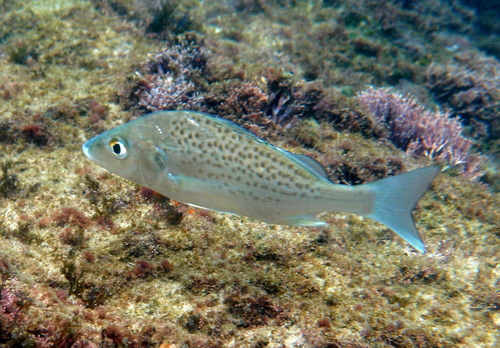
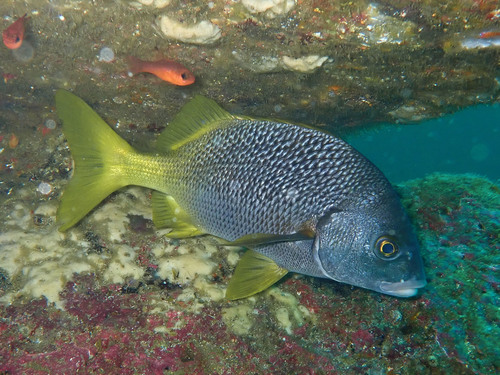
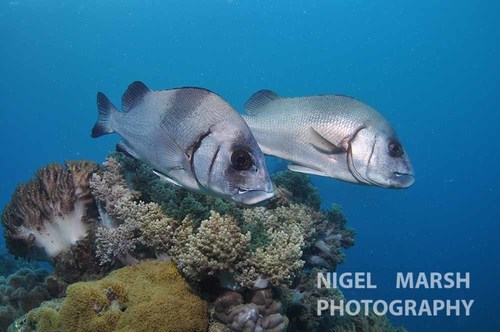
Plectorhinchus gibbosus has fleshy lips that grow noticeably larger and thicker as the fish ages. It has 6 pores on its chin, and lacks a median pit there. Its dorsal fin is made up of 14 spines and 15 to 16 soft rays, while the anal fin has 3 spines and 7 to 8 soft rays. The overall body colour ranges from silvery-grey to brownish, with dark edges on each scale, a darkened face, and a thin dark bar on the front of the operculum, which has a black rear margin. The soft-rayed sections of the dorsal fin, the anal fin, and the caudal fin are all dusky in colour. Juvenile Plectorhinchus gibbosus are brown, with a pink or transparent caudal fin. They mimic fallen leaves by drifting while holding their bodies so their sides run parallel to the water surface. This species reaches a maximum total length of 75 cm (30 in).
Plectorhinchus gibbosus has a broad distribution across the Indo-Pacific region. It occurs along the eastern coast of Africa from Kenya to South Africa, and along the southern coast of Asia, extending east into the Pacific Ocean as far as Polynesia. Its range reaches north to the Ryukyu Islands of southern Japan, and south to Australia. In Australia, it can be found from Ningaloo Reef in Western Australia, along the northern coasts, and south along the eastern coast as far as Flinders Island in Tasmania. It is also present around Lord Howe Island and Norfolk Island in the Tasman Sea, and off the Indian Ocean islands of Socotra, the Seychelles, Madagascar, and the western Mascarenes.
This species lives at depths between 8 and 25 m (26 to 82 ft), inhabiting coastal reefs, sandbanks, areas near estuaries, and will enter fresh water. Small juveniles live along sheltered sandy shorelines, where they float on their sides camouflaged to look like fallen leaves. Adults prefer protected waters around inshore reefs, but can also be found offshore in deeper water, and are often recorded forming small groups. In captivity, this species is known to feed on crustaceans, other invertebrates, and fish. It is an oviparous species that spawns as distinct mating pairs.