About Plectorhinchus gaterinus (Forsskål, 1775)
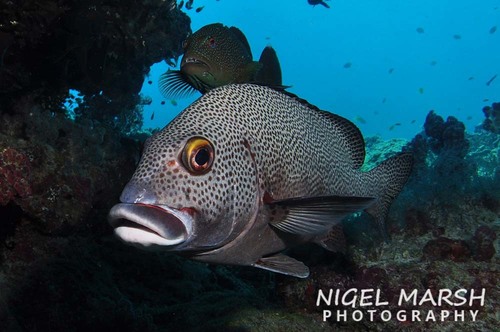
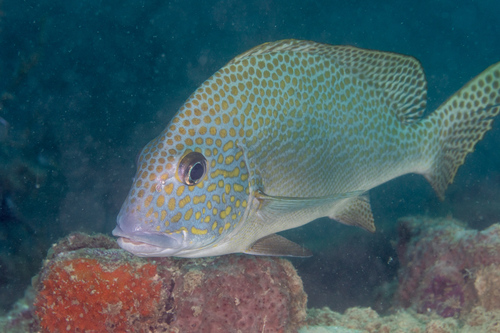
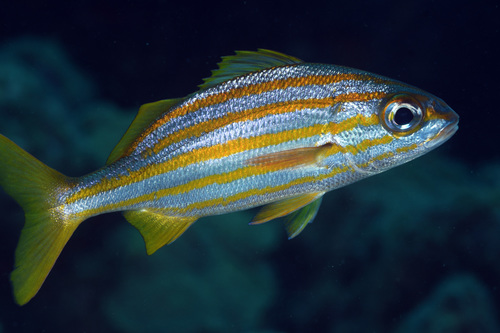
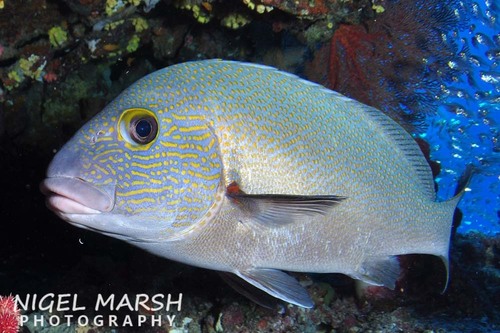
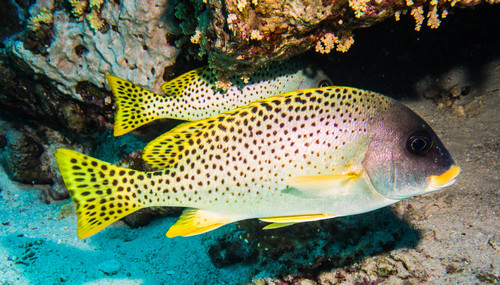
Plectorhinchus gaterinus has fleshy lips that do not have a swollen appearance. There are 6 pores on its chin, and it does not have a median pit. Its pelvic fins are longer than its pectoral fins. The fish is predominantly yellowish grey, with a greenish back and a yellowish belly. Rows of dark grey or black-brown spots mark its body and fins. Juvenile Plectorhinchus gaterinus are light silver-grey, with yellow fins and 5 to 7 brown horizontal bands. When juveniles grow to a standard length of 10 to 12 cm (3.9 to 4.7 in), these bands split into lines of spots. The dorsal fin of this species has 13 spines and 19-20 soft rays, while the anal fin has 3 spines and 7 soft rays. This species reaches a maximum total length of 50 cm (20 in), with 35 cm (14 in) being a more typical size. Plectorhinchus gaterinus is native to the Western Indian Ocean. It occurs along the eastern coast of Africa from KwaZulu Natal north into the Red Sea, reaching as far north as the Gulf of Aqaba. It can also be found in the Sea of Oman, the Persian Gulf, and around the islands of the Seychelles, Mauritius, Madagascar, Réunion, and Comoro Islands. One juvenile was found in the gut of a European squid (Loligo vulgaris) in the Aegean Sea, which has been suggested to indicate Lessepsian migration through the Suez Canal, but this is generally considered unlikely. Plectorhinchus gaterinus inhabits depths of 5 to 55 m (16 to 180 ft), where it lives on coastal reefs, sand banks, and near estuaries. During the day, it is frequently found in large groups below ledges or along reef slopes. Juveniles most often occur in seagrass beds. This species feeds mainly on smaller fishes and crustaceans. A spawning aggregation has been observed in the Persian Gulf off the coast of Kuwait. It is an oviparous species that spawns in distinct pairs.