About Plectorhinchus chaetodonoides Lacepède, 1801
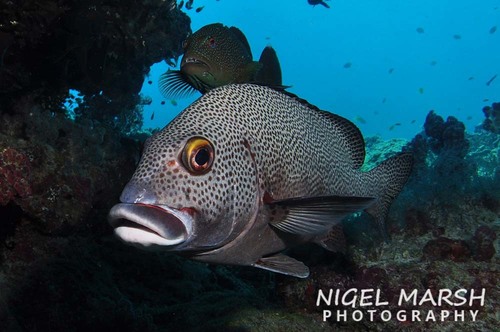
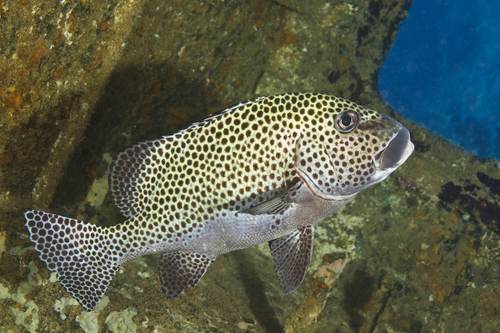
Plectorhinchus chaetodonoides has fleshy lips that become moderately swollen as the fish grows. It has 6 pores on its chin, with no central pit. Its dorsal fin usually has 12 spines (rarely 11), plus 18 to 20 soft rays; the height of the soft-rayed section of the dorsal fin is roughly equal to the length of its base. Juveniles are brownish with large, separate creamy white blotches across the body, and these blotches develop brown spotting as the fish matures. As the fish grows into adulthood, its coloration slowly develops a greyish background marked with large, dark brown spots; these spots are larger in diameter than the fish’s iris. The maximum recorded total length of this species is 72 cm (28 in), though 60 cm (24 in) is more typical, and the maximum published weight is 7 kg (15 lb). Juveniles are thought to be Batesian mimics of poisonous flatworms. The caudal fin of juveniles is deeply forked with wide, rounded lobes; most of each lobe is white, marked with a large brown spot. In adults, the caudal fin is much less forked. This species is distributed across the eastern Indian Ocean and western Pacific Ocean, ranging from the Maldives and Mauritius east to Tonga, north to the Ryukyu Islands, and south to the Great Barrier Reef. One individual was observed off St. Martin in the West Indies in 2007, and this is considered to most likely be a deliberately released aquarium fish. Plectorhinchus chaetodonoides inhabits coral-rich areas of clear lagoons and seaward reefs. Adults are solitary; they live near ledges or caves and shelter beneath these structures during the day. Juveniles shelter within corals. It is a carnivorous species that forages at night, preying on benthic invertebrates including crustaceans and molluscs, as well as fishes. Juveniles typically swim with a head-down posture, wildly undulating their fins as they move. This behavior may mimic toxic or distasteful platyhelminths or nudibranchs, providing protection from predation.