About Plectorhinchus albovittatus (Rüppell, 1838)
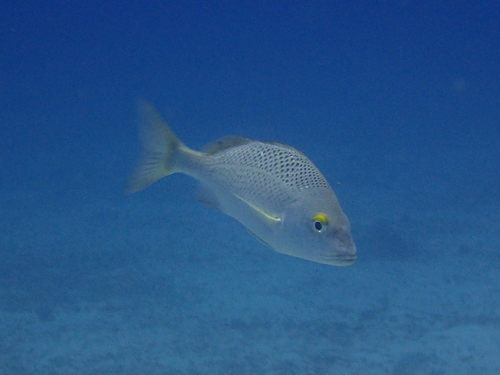
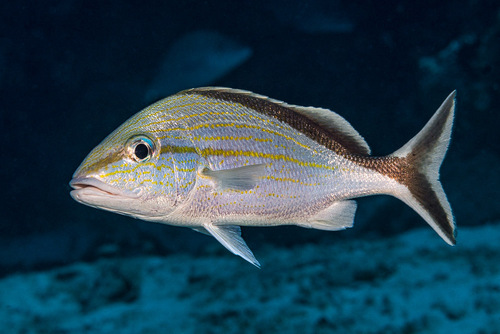
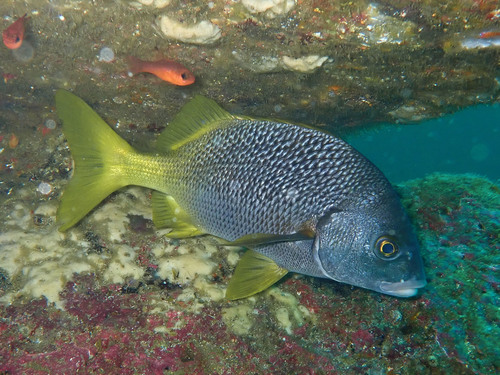
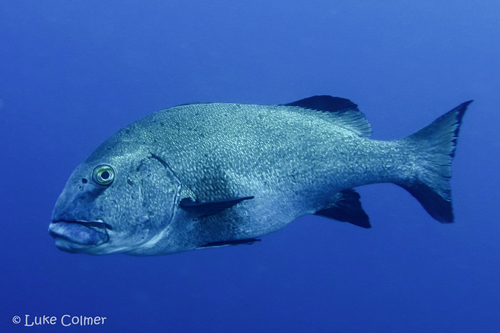
Plectorhinchus albovittatus, first described by Rüppell in 1838, has fleshy lips that grow more swollen as the fish ages. There are 6 pores on its chin, with no central pit present. Its dorsal fin holds 12 or 13 spines (most often 13) and 16 to 20 soft rays, while the anal fin has 3 spines and 7 soft rays. Juvenile individuals are brown, with a paler lower body than upper body, and marked with 3 slender white bands: one runs down the snout, a second starts on the nape and extends to the tail, and the third sits on the upper part of the dorsal fin. The spiny portion of the dorsal fin is pale brown or cream, with a thin dark brown margin. The soft-rayed portion of the dorsal fin is dark brown, with a pale horizontal stripe and a thinner stripe above it; both stripes extend to the rear margin of the dorsal fin. The caudal fin is dark brown on the lower half and white on the upper half, with darker tips and a dark brown band running diagonally across its upper lobe. The anal fin is dark brown, with paler rear rays. Pectoral fins range in colour from transparent to very light brown, while pelvic fins have sooty brown tips. Adult fish are overall grey to grey-brown on the upper body and flanks. Their pectoral, pelvic, and anal fins are blackish; the lower lobe and upper tip of the caudal fin are black. The front section of the soft-rayed part of the dorsal fin is black, while the spiny part of the dorsal fin is dusky to black. The lower lip and chin are white, and the abdomen is silvery grey to white. This species reaches a maximum standard length of 100 cm (39 in).
Plectorhinchus albovittatus occurs in the Indo-West Pacific region, ranging from the coast of East Africa and the Red Sea eastward to Polynesia, north to Japan, and south to New South Wales.
This species lives in clear lagoons and on seaward reefs; juveniles are found in brackish water or shallow turbid coastal areas. Adults are normally solitary, though they are rarely seen in pairs, and may inhabit deep reefs or areas near sea mounts. In Palau, this species has been observed gathering to spawn each year around the new moon in April or May. It is an oviparous species that spawns as distinct pairs. During daylight, they shelter in the deeper sections of surge channels that cut through reefs.