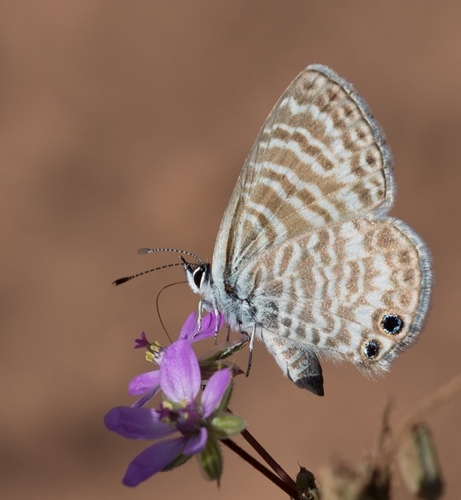
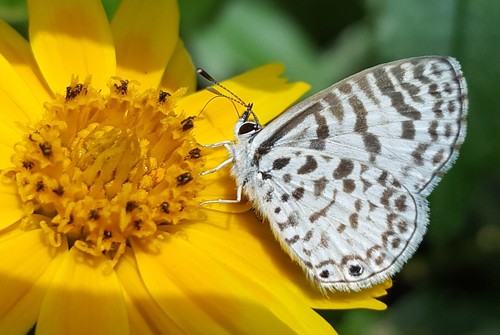
About Plebejus argus (Linnaeus, 1758)
Adult Plebejus argus are very similar in appearance to Plebejus argyrognomon (Reverdin's blue). They have a deep dark blue color on their upper wing surfaces, with a broad black border, and glittering scales on the underside of the hindwing. The two species differ in several details that vary between individual P. argus. On the upperside of P. argus, the blue gloss is deeper, darker, and duller, with a faint violet tint, and does not extend as far toward the wing margin. The wing margin is broader and appears blacker; any row of dark submarginal dots that sometimes appears on the upperside of the hindwing always lies within the black border in this species. On the underside, nearly all individuals of both sexes of P. argus have a strongly glittering blue-green dusting at the base of the wings; this dusting is usually, but not always, absent in P. argyrognomon. P. argus is also typically smaller than P. argyrognomon. The larva (caterpillar) of P. argus is highly variable in color. It is usually light green with dark dorsal spots, but may sometimes be grey or dark brown with pale spots. In early summer and autumn, larvae feed on plants including Coronilla, Trifolium, Colutea, and Genista. Both larvae and pupae associate with the ant Formica cinerea, and live inside this ant's nests. The pupa is elongate, green with a red dorsal line, and the upper abdomen is yellowish green. Southern populations have two broods per year, with adults active in May and again starting in July, while northern populations only have one brood per year. Like their associated ant, P. argus prefers habitats with sandy soil. Plebejus argus is distributed across the Palearctic. In the United Kingdom, the species experienced severe population decline during the nineteenth and twentieth centuries. It is generally considered endangered, is extinct in Northern United Kingdom, and is found primarily in the southern and western parts of the country. P. argus lives in three main habitat types: heathland, mossland, and limestone grassland. Heathland becomes suitable for P. argus after disturbances like burning and cutting of mature heath. These disturbances create an early-stage heathland landscape with high cover of Erica cinerea, short Calluna vulgaris, and patches of bare ground, which meets the butterfly's habitat requirements. This suitability ends when native shrubs mature, covering the bare ground and vegetation margins the butterflies use for oviposition. Mossland is similar to wet heathland, with soil made primarily of peat that supports Ericaceae, one of the host plant families for P. argus. Ericaceae grows alongside other grasses, sedges, and rushes here. While the main human disturbance for heathland is quarrying, mossland is shaped by peat digging, which contributes to the transient, shifting nature of this habitat. The host plants from the first two habitat types, Ericaceae and Leguminosae, are less abundant in the third habitat, limestone grassland. In limestone grassland, P. argus primarily uses herbaceous Cistaceae and Leguminosae as host plants. The bare ground and vegetation margins critical to P. argus' life cycle are created here through animal grazing and natural disturbance from the area's stony topography. P. argus uses shrubs for roosting, resting, basking, locating mates, and seeking shelter, so higher numbers of the butterfly are found close to shrub-dense areas. Most of the population gathers near these shrubs during cold, cloudy, windy weather. When weather is warm, sunny, and calm, P. argus spends less time in shrub-dense habitats, and more time flying and searching for host plants in calcareous heath-rich areas, which are typically found on exposed hillsides. For this reason, P. argus' used habitat often appears to shift with weather conditions. In addition to habitat selection based on host plants and topography, P. argus population density correlates with the nest density of its mutualist ants, Lasius niger and Lasius alienus. Adult P. argus are typically very sedentary, moving only around 20 metres (66 ft) per day. Because of this, the butterflies colonize discrete territories and patches of land. A small number of butterflies do disperse, moving over a kilometer between separate colonies, but this is rare. As a result, the species tends to form metapopulations. In the United Kingdom, P. argus has experienced habitat loss and fragmentation caused by industrial agricultural development, new forestry practices, and general landscape development. Additionally, the total area of heathland in the UK has decreased by over fifty percent, which has heavily impacted this butterfly, for which heathland is a primary habitat. Remaining heathland also declined in quality due to shifting environmental conditions. Historically, rabbits kept vegetation short through grazing, which created favorable habitat for P. argus. In the mid-twentieth century, the myxomatosis virus caused a major decline in the UK rabbit population, which allowed grass to grow too long to support P. argus. The life cycle of Plebejus argus has four main stages: eggs, larvae, pupa, and adults.